
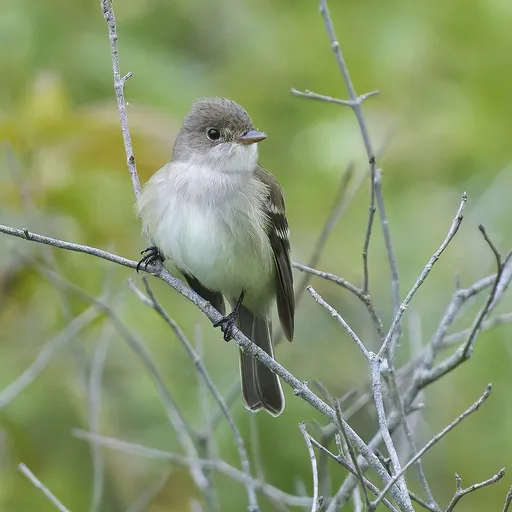
Willow Flycatcher
Empidonax traillii
Least Concern
Listen
XC248784 · Niels Krabbe · Orellana: river island at Añangu, Ecuador · CC BY-SA 4.0
Overview
The willow flycatcher (Empidonax traillii) is a small, migrant insect-eating bird belonging to the tyrant flycatcher family, native to North America. It is currently classified as Least Concern on the IUCN Red List.
Identification
- Brown-olive upperparts, darker on the wings and tail, with whitish underparts washed with olive-gray on the breast.
- Features an indistinct white eye ring, white wing bars, and a small bill with a gray upper part and orangish lower part.
- The song is described as a sneezed 'fitz-bew' and the call is a dry 'whit'.
Habitat
Breeding habitat consists of deciduous thickets, especially willows and often near water, across the United States and southern Canada. These neotropical birds migrate to winter in Mexico and Central America, and occasionally as far south as Ecuador, typically selecting habitats near water.
Diet
Willow flycatchers are generalist insectivores that forage as 'sit-and-wait' predators, perching near the top of a shrub to fly out and catch insects on the wing, though they also glean insects off leaves and stems. Their diet varies by region, consisting largely of Diptera in Ontario but favouring Lepidopterans, mayflies, and snakeflies in California.
Did you know?
At one time, the willow flycatcher and the alder flycatcher were considered a single species known as Traill's flycatcher, and their song is the only reliable method to distinguish them in the field. The species was named by John James Audubon to honour his friend, the Scottish physician and zoologist Thomas Stewart Traill.
Sources
- Wikipedia · CC BY-SA 4.0
- Wikidata · CC0 1.0