
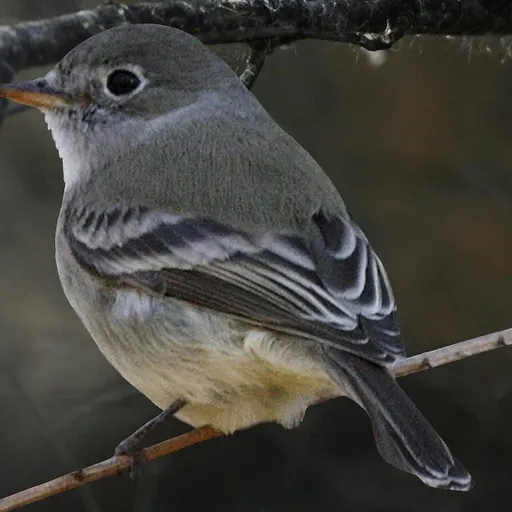
American Grey Flycatcher
Empidonax wrightii
Least Concern
Overview
The American grey flycatcher (Empidonax wrightii) is a small, insectivorous passerine bird belonging to the tyrant flycatcher family. It is a common resident of the arid regions of western North America, particularly thriving in the Great Basin.
Identification
- Small bird measuring approximately 15 cm in length with pale grey upperparts, darker on the wings and tail, and whitish underparts that may show a slight yellow wash in fresh plumage.
- Distinguishing physical features include white wing bars, a pale supraloral band, and a relatively long, narrow bill with a long tail.
- Exhibits a unique behavioural trait of a downward tail wag, contrasting with the rapid upward flick typical of other Empidonax species.
- Males produce a strong, two-syllable song described as 'chuwip' or 'wilip', often interrupted by a weaker, higher-pitched 'teeap' or 'seep'.
Habitat
Breeding habitats consist of shrubland, open woodland, or forest with bare understories, typically dominated by sagebrush but also including juniper, pinyon pine, and ponderosa pine. The breeding range extends from southernmost British Columbia across a narrow zone in central Washington to eastern Oregon and California, stretching east across Nevada, southern Idaho, Utah, and northern Arizona to southwestern Wyoming, western Colorado, and northwestern New Mexico. During migration, riparian areas with willow, oak, or mesquite are frequently used, while wintering grounds comprise arid open and semi-open areas with scrub and scattered trees in Baja California Sur, southeastern Arizona, and central Mexico.
Diet
The diet consists entirely of insects and other small invertebrates, which are primarily caught in flight or taken from the ground. The bird typically waits on an open perch, such as a shrub or low tree branch, to fly out and catch passing insects, though it occasionally hovers to glean prey from foliage or bark. While fruit may be eaten in winter, this has not been confirmed.
Did you know?
Taxonomic confusion once led to the discovery that the type specimen designated for the American dusky flycatcher was actually an American grey flycatcher, resulting in the latter retaining the name Empidonax wrightii and the former being renamed E. oberholseri.
Sources
- Wikipedia · CC BY-SA 4.0
- Wikidata · CC0 1.0