
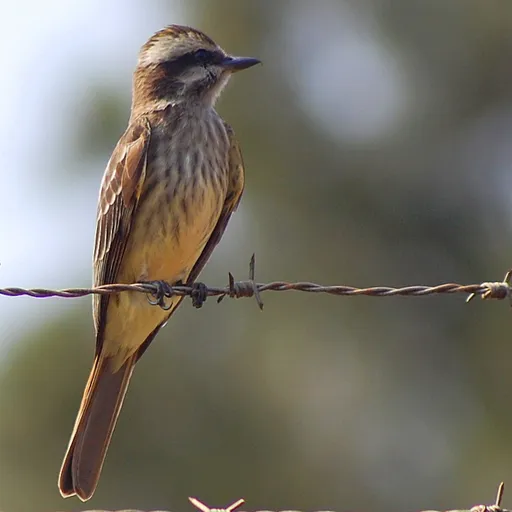
Variegated Flycatcher
Empidonomus varius
Least Concern
Overview
The variegated flycatcher (Empidonomus varius) is a small tyrant flycatcher found throughout South America and Trinidad. It is considered a species of Least Concern by the IUCN due to its very large range and stable population.
Identification
- 18 to 19 cm in length with a blackish bill featuring a pale pinkish base to the mandible.
- Adults possess a blackish crown with a mostly hidden yellow patch, a long white supercilium, and dusky upperparts with pale whitish streaks giving a mottled appearance.
- Wings are dusky with wide white edges on the coverts and flight feathers, while the tail is dark with rufous feather edges.
- Usually quiet, but emits a harsh 'chee-chee-chu' call with a dragged-out last note, or weak, high-pitched 'pseee' and 'zureee' calls.
Habitat
Inhabits varied open landscapes including forest edges, secondary and gallery forests, savannas with scattered shrubs, and parks, ranging from sea level to 1,900 m in Venezuela and 1,200 m in Brazil. Its range covers Trinidad and most mainland South American countries except Chile, with occasional vagrant records in the United States and Canada.
Diet
Feeds primarily on insects, often hawking prey from perches in the open, and also consumes fruit, particularly during migration. It usually forages alone but occasionally joins mixed-species feeding flocks.
Did you know?
Shiny cowbirds sometimes parasitize the variegated flycatcher's nest, which is a flattish bowl made of twigs and leaf stems typically placed in the fork of a horizontal branch up to 8 m above the ground.
Sources
- Wikipedia · CC BY-SA 4.0
- Wikidata · CC0 1.0