
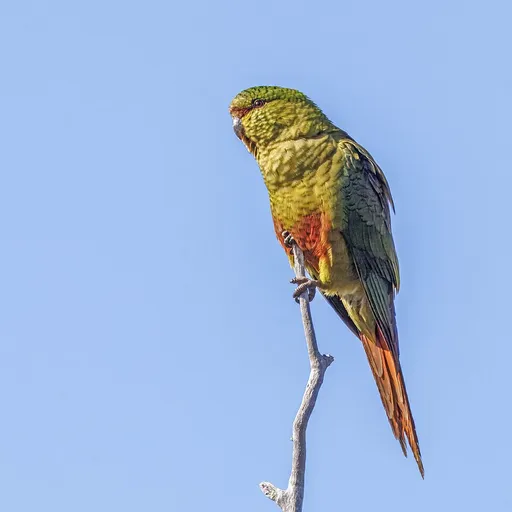
Austral Parakeet
Enicognathus ferrugineus
Least Concern
Overview
The austral parakeet, also known as the emerald parakeet or Enicognathus ferrugineus, is the southernmost of all parrot species. It is classified as Least Concern on the IUCN Red List and is found primarily in southern South America.
Identification
- Length ranges from 28 to 36 cm, with no sexual dimorphism in appearance.
- The nominate subspecies features a dull reddish forehead and lores contrasting with a yellow-green face, along with dull green upperparts.
- Underparts are yellowish green with a dull reddish belly patch that appears scaly due to dark feather edges.
- Most common vocalisation is a nasal grating note repeated in series, such as 'grrreh-grrreh-grrreh...', often mixed with a higher-pitched 'kreeh'.
Habitat
Found in Argentina, Chile, and possibly the Falkland Islands, the species primarily inhabits southern beech forest and woodlands dominated by oaks and Drimys andina. It also occurs in nearby semi-open areas, ranchlands, and cultivated regions, ranging from near sea level in the far south up to 2,000 m in the north.
Diet
Foraging in flocks that can number up to 100 individuals, the austral parakeet eats seeds of grasses, bamboo, and Araucaria araucana, as well as fruits, berries, acorns, and leaf buds. In the northernmost part of its Argentinian range, it has been observed feeding on insect larvae.
Did you know?
This species holds the distinction of being the southernmost parrot in the world. It is also notable for its large clutch size, producing five to eight eggs per breeding season.
Sources
- Wikipedia · CC BY-SA 4.0
- Wikidata · CC0 1.0