
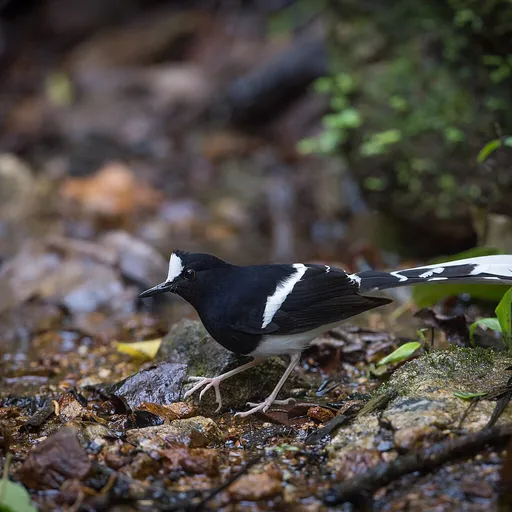
White-crowned Forktail
Enicurus leschenaulti
Least Concern
Overview
The white-crowned forktail (Enicurus leschenaulti) is a species of forktail in the family Muscicapidae, noted as the largest of its kind. It is a shy bird that maintains a close association with water, inhabiting forests in South and Southeast Asia. Classified as Least Concern by the IUCN, it possesses a stable population estimated at greater than 10,000 individuals.
Identification
- Largest of the forktails, measuring 25 to 28 centimetres in length and weighing 27 to 38 grams.
- Prominent white crown and forehead, often visible as a slight crest, contrasting with a black face, throat, and breast.
- Long, deeply forked tail with white tips and three narrower white bands; wings are largely black with a white band across the greater coverts.
- Males produce a long, complex whistled song that may include fading whistles, clicking noises, or bell-like sounds.
Habitat
Found in subtropical or tropical moist lowland and montane forests across South and Southeast Asia, including parts of India, China, and Indonesia. The bird frequents fast-flowing rivers, waterfalls, and streams, often preferring areas screened by dense vegetation. Its elevational range varies seasonally, from 185 to 2,400 metres above sea level.
Diet
Forages along the edges of streams and in the water for invertebrates, including black beetles, water crickets, springtails, and caterpillars. As a shy bird, it flies close to the ground while calling and frequently wags its tail.
Did you know?
Nests are constructed of moss, plants, leaves, and wood fibre, and are sometimes placed behind waterfalls, with the birds flying through the water to reach them.
Sources
- Wikipedia · CC BY-SA 4.0
- Wikidata · CC0 1.0