
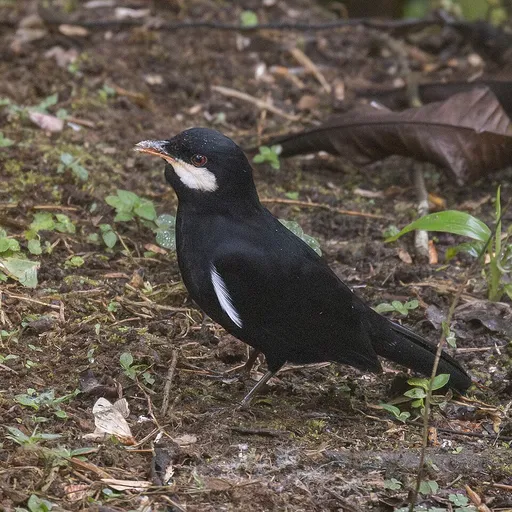
Black Solitaire
Entomodestes coracinus
Least Concern
Overview
The black solitaire (Entomodestes coracinus) is a species of thrush found in the Chocó region of west-central Colombia and northwestern Ecuador. It is classified as Least Concern by the IUCN, though its population is believed to be decreasing.
Identification
- Adults are almost entirely glossy black, featuring silvery white cheeks, white underwing coverts, and white lower halves on outer tail feathers.
- The bird measures approximately 23 cm in length with a red iris, a black maxilla, a yellowish-orange mandible, and dark greyish-brown legs.
- Its song is infrequent, described as a weak but surprisingly far-carrying long wreeeeeeeenh with a ringing yet almost nasal quality, while its call is a much weaker tseeu.
Habitat
Inhabiting the interior and edges of wet forest in tropical and lower subtropical zones, it especially favours forests dense with mosses and occasionally uses secondary forest. Its range spans from Chocó Department in Colombia to Pichincha Province in Ecuador, occurring between 400 and 2,300 m in Colombia and 1,100 to 1,600 m in Ecuador.
Diet
The black solitaire feeds on fruit, which it takes at all levels of the forest. It primarily forages singly or in pairs but will share fruiting trees with small numbers of its own and other species.
Did you know?
It is described as a rather unpredictable altitudinal migrant. Its breeding nests are cup-shaped structures made of moss lined with rootlets, typically placed in dense vegetation such as bromeliads and vine tangles.
Sources
- Wikipedia · CC BY-SA 4.0
- Wikidata · CC0 1.0