
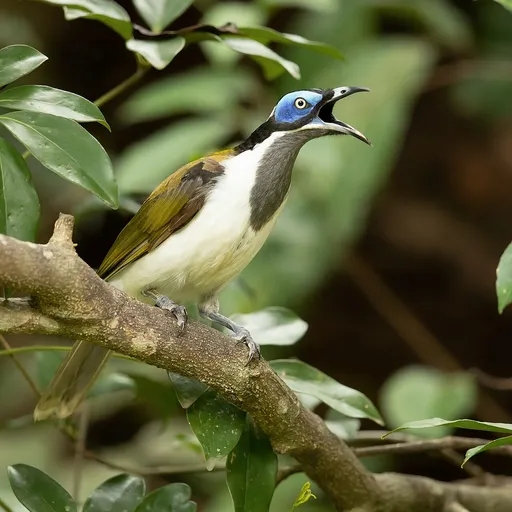
Blue-faced Honeyeater
Entomyzon cyanotis
Least Concern
Overview
The blue-faced honeyeater, also known as the bananabird, is a passerine bird in the honeyeater family and the sole member of its genus. It is classified as Least Concern on the IUCN Red List.
Identification
- A large honeyeater measuring approximately 29.5 cm in length, with a wingspan of 44 cm.
- Distinctive plumage featuring a black head and throat, white underparts, golden-olive upperparts, and a white stripe around the nape and cheeks.
- Characterised by bright blue bare skin on the face in adults, whereas juveniles have yellow or greenish patches in the same location.
- Produces a piping call before dawn described as 'ki-owt' or 'woik', along with squeaking noises while flying and harsh squawks when mobbing.
Habitat
This species inhabits a variety of environments including rainforest, dry sclerophyll forest, open woodland, Pandanus thickets, mangroves, and urban parks or gardens. It is found across northern and eastern Australia, from the Kimberleys and Top End south to the Riverina and Victoria, as well as in southern New Guinea.
Diet
The diet consists mainly of invertebrates, supplemented by nectar and fruit. The species has a particular propensity for feeding on the flowers and fruit of bananas in north Queensland, which has led to its colloquial name 'bananabird'.
Did you know?
The bird is sometimes called the morning-bird because it produces calls before other bush birds are active. It is also known for adopting old nests of other species, such as the grey-crowned babbler, and renovating them for its own use.
Sources
- Wikipedia · CC BY-SA 4.0
- Wikidata · CC0 1.0