
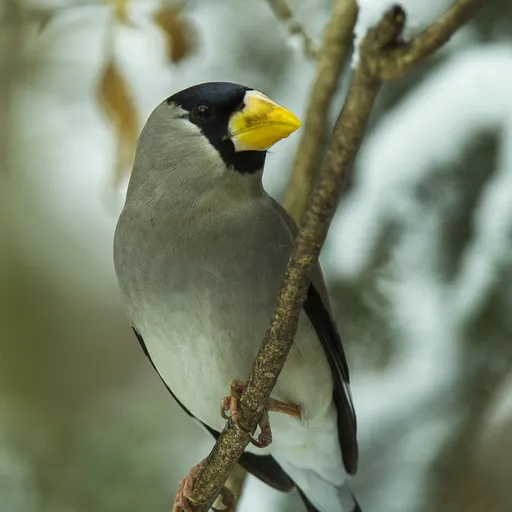
Japanese Grosbeak
Eophona personata
Least Concern
Overview
The Japanese grosbeak, also known as the Ikaru, is a large finch native to the East Palearctic region. It is sometimes referred to as the Japanese or masked hawfinch due to its superficial similarities to the Eurasian hawfinch.
Identification
- Large size, measuring 18 to 23 cm in length, with a signature large, pointed bright yellow bill.
- Adults feature a large black marking extending from the nape to the chin and ear-coverts, contrasting with a pale whitish-grey neck side and gingery or tawny-brown flanks.
- Wings and tail are black, marked by a white patch on the inner-coverts and a central white band in the primaries visible in flight.
- Song consists of a series of four flutey whistles, accompanied by a short, hard tak tak note in flight.
Habitat
Found in deciduous or mixed forests, particularly in valleys rather than hillsides, as well as in oak and birch groves, well-wooded parks, and gardens. The nominate race occurs throughout Japan, while the alternate subspecies breeds in Amur, Ural, and Manchurian regions before migrating to winter in Hebei, Beijing, or North Korea.
Diet
Forages primarily on a variety of seeds and insects, often remaining hidden in foliage near the tree canopy. In winter, the diet consists mainly of cedar nuts, birch seeds, and berries, while summer feeding is largely insectivorous, targeting caterpillars and beetles.
Did you know?
Although it can be deceptively secretive by staying hidden in foliage, its location is regularly betrayed by its distinctive vocalisations.
Sources
- Wikipedia · CC BY-SA 4.0
- Wikidata · CC0 1.0