
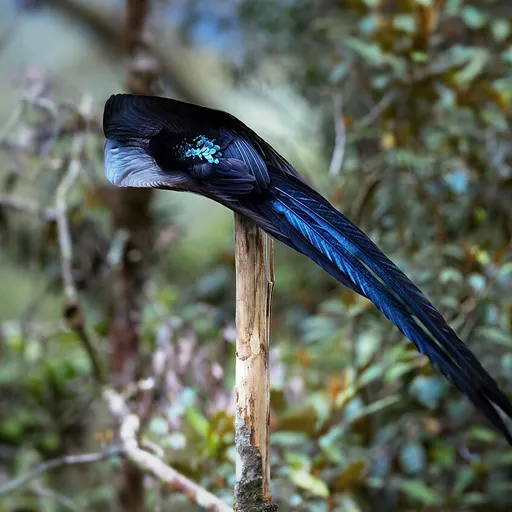
Black Sicklebill
Epimachus fastosus
Least Concern
Overview
The black sicklebill (Epimachus fastosus) is a large, bizarre bird of paradise that is the second-longest species in its family. Despite its classification as Least Concern, the species is listed in Appendix II of CITES and is experiencing a population decline due to habitat loss and hunting.
Identification
- Male: Approximately 110 cm in length with a long, silver, slightly downcurved bill, bright yellow mouth, and scarlet-red eyes surrounded by iridescent blue-green scaly feathers.
- Male Plumage: Jet black back and head with metallic blue iridescence, silky brownish-black underparts, and two large pectoral fans tipped with iridescent blue-green.
- Female: About 53 cm in length, appearing generic with an olive-light brown upper body, orange-brown crown, and creamy belly with black barring; distinguishable by brown eyes.
- Call: Males produce a powerful, far-carrying, bubbling 'kwit-it kwit-it' sound.
Habitat
Found throughout most of central New Guinea and the Vogelkop region in the northwest. The species inhabits montane forests at altitudes ranging from 1,800 to 2,150 m.
Diet
Primarily omnivorous, feeding on fruits, insects, and other animal prey in equal proportions. It typically forages solitarily, although mixed foraging flocks are not uncommon.
Did you know?
During courtship, males rub the rachides of their flight feathers together to create woodpecker-like beating sounds while orbiting the female's face. The genus name Epimachus means 'equipped for battle', a reference to the machine gun-sounding calls produced by this group of birds.
Sources
- Wikipedia · CC BY-SA 4.0
- Wikidata · CC0 1.0