
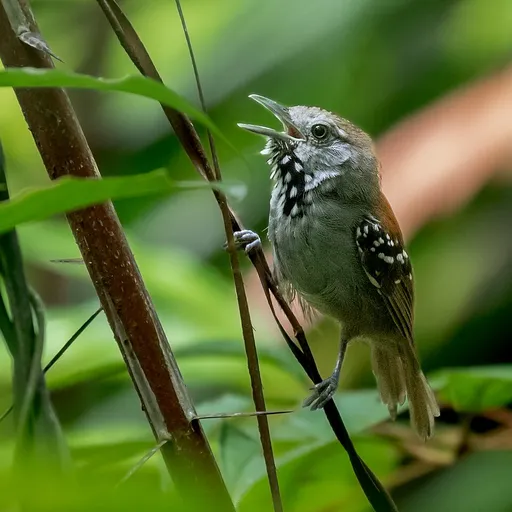
Rio Madeira Stipplethroat
Epinecrophylla amazonica
Least Concern
Overview
The Rio Madeira stipplethroat, Epinecrophylla amazonica, is a species of bird in the family Thamnophilidae, commonly known as the typical antbirds. Recognised as a distinct full species in 2014, it is listed as Least Concern on the IUCN Red List due to its large range and stable population.
Identification
- Length of 10 to 11 cm with a weight of 8.7 to 9 g, featuring a dark gray bill, legs, and feet.
- Males of the nominate subspecies display a mottled yellowish brown face, a white throat with black streaks, and dark red upperparts, while females have duller red upperparts and a dull yellow-brown throat.
- Song consists of an extra-high, very thin, descending, rapid shiver similar to that of the rufous-backed stipplethroat but delivered slower with longer notes and intervals.
- Calls include a doublet of abrupt notes with the second higher-pitched, an abrupt single note, and a high-pitched rattle.
Habitat
Primarily inhabiting lowland terra firme evergreen forest, with occurrence in more upland forest in Bolivia. Its range covers south-central Amazonian Brazil, Peru's Department of Madre de Dios, and northern Bolivia's Pando Department, reaching elevations up to 400 m.
Diet
Feeds on arthropods, especially insects and spiders, typically foraging singly, in pairs, or in small family groups within mixed-species feeding flocks. It forages in the forest understory up to 3 m above the ground, gleaning prey almost entirely from dead leaves on trees, vine tangles, and small palms.
Did you know?
Nothing is currently known about the breeding biology of the Rio Madeira stipplethroat. It was long treated as a subspecies of the rufous-backed stipplethroat before being recognised as a separate species in 2014.
Sources
- Wikipedia · CC BY-SA 4.0
- Wikidata · CC0 1.0