
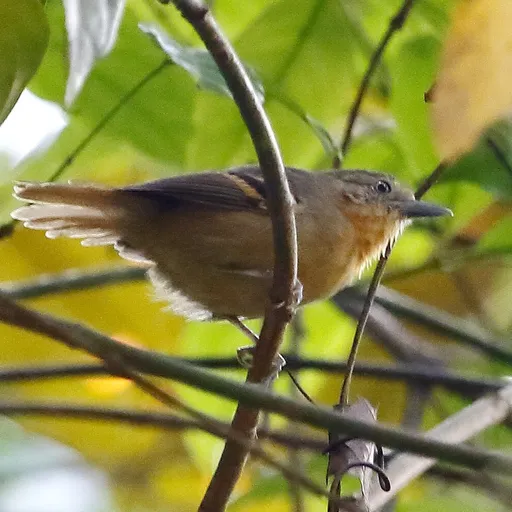
White-eyed Stipplethroat
Epinecrophylla leucophthalma
Least Concern
Overview
The white-eyed stipplethroat, previously known as the white-eyed antwren, is a small bird in the family Thamnophilidae. It is found across Bolivia, Brazil, and Peru and is classified as a species of Least Concern by the IUCN.
Identification
- Adults of the nominate subspecies have a gray-brown face and crown, a black throat with white spots, and reddish tail and flight feathers.
- Males possess blackish-brown wing coverts with large cinnamon-tinged white tips, while the breast and upper belly are gray, gaining an ochraceous tinge near the vent.
- Females exhibit a light olive-brown face and a cinnamon throat, with light olive-brown underparts that may have a variable cinnamon tinge.
- The song is described as a "very high, very thin, slightly descending 'tsitsitsituw'", accompanied by abrupt downslurred notes and rubbery rattles.
Habitat
The species mostly inhabits lowland terra firme and transitional evergreen forests, favouring areas with dense understories containing dead leaves caught in vine tangles and palm thickets. Its range spans from northwestern Peru and eastern Peru into western and central Brazil, as well as northern Bolivia. While it occurs in bamboo stands in Bolivia and eastern Peru, it is rarely found in bamboo in Mato Grosso, Brazil.
Diet
This bird feeds on arthropods, specifically cockroaches, crickets, katydids, and beetles. It forages singly, in pairs, or in small family groups, usually within mixed-species flocks. Prey is taken almost entirely by gleaning from dead leaves on trees and those caught in vine tangles and palms, typically in the understory up to 6 m but occasionally higher.
Did you know?
Males engage in territorial displays from perches less than 1 m apart, where they lower their heads, puff up their back plumage, and sway back and forth while continuously vocalising. The species was moved to the genus Epinecrophylla from Myrmotherula based on genetic and vocal studies to highlight a common feature and distinguish them from other antwrens.
Sources
- Wikipedia · CC BY-SA 4.0
- Wikidata · CC0 1.0