
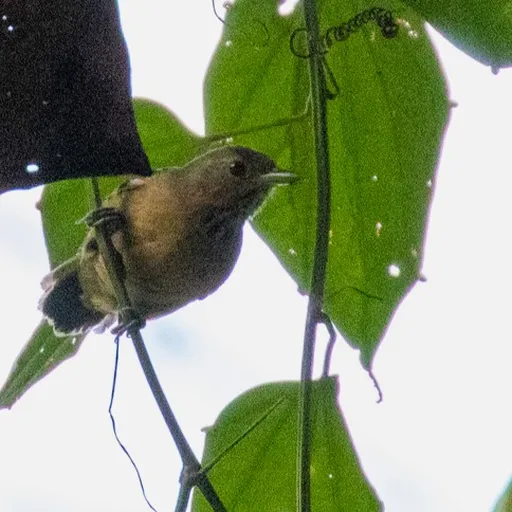
Foothill Stipplethroat
Epinecrophylla spodionota
Least Concern
Listen
XC249822 · Niels Krabbe · Morona-Santiago: w-slope Cord. de Cutucú, Ecuador · CC BY-SA 4.0
Overview
The foothill stipplethroat, Epinecrophylla spodionota, is a species of bird in the family Thamnophilidae, commonly known as the typical antbirds. Previously referred to as the foothill antwren, it is classified as Least Concern by the IUCN Red List despite being a year-round resident in its range.
Identification
- Size: Small bird measuring 10 to 11 cm in length and weighing 9 to 10.5 g.
- Plumage: Males feature a mostly gray face and a distinctive black throat with white spots, paired with brown-tinged dark gray upperparts and a dark reddish yellow-brown rump; females have yellow-ochre faces and underparts with darker mottling on the throat and olive-brown upperparts.
- Song: Emits a trill of abrupt, sibilant notes that ascend sharply before gradually dropping in pitch, accompanied by short, high-pitched rattles.
Habitat
Inhabits the understorey of foothill and lower montane evergreen forest in Colombia, Ecuador, and Peru. The nominate subspecies is found on the eastern side of the Andes from southern Colombia through Ecuador to northern Peru, while subspecies E. s. sororia occurs in Peru south of the Marañón River. Elevations range from 500 to 1,425 m, with lower Andean slopes representing some of the most at-risk areas for deforestation.
Diet
Feeds primarily on arthropods, especially insects and probably spiders. It forages in the forest understory up to 4 m high, typically gleaning prey from dead leaves on trees, vine tangles, and small palms, though it occasionally reaches up to 8 m. It usually forages singly, in pairs, or as part of a mixed-species feeding flock.
Did you know?
This species and its congeners were previously classified as antwrens but were renamed 'stipplethroats' to highlight a common feature and distinguish them from Myrmotherula antwrens. Its breeding season includes March, but little else is known about its breeding biology.
Sources
- Wikipedia · CC BY-SA 4.0
- Wikidata · CC0 1.0