
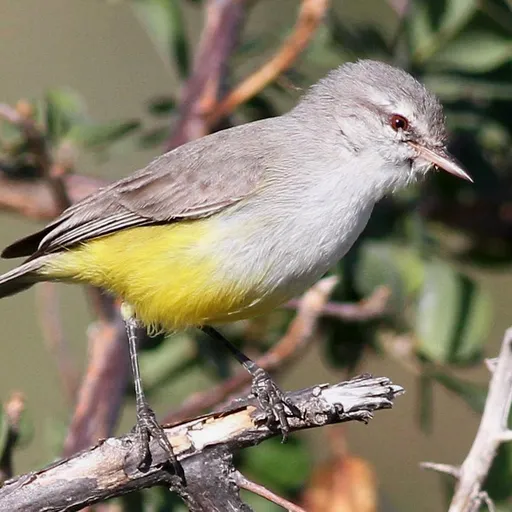
Yellow-bellied Eremomela
Eremomela icteropygialis
Least Concern
Overview
The yellow-bellied eremomela (Eremomela icteropygialis) is a very small Old World warbler that is classified within the family Cisticolidae. It is a common breeding species found throughout sub-Saharan Africa, inhabiting open woodlands, savannahs, and dry scrub. The species is assessed as Least Concern on the IUCN Red List due to its large population and extensive range.
Identification
- A very small bird, approximately 10 cm long and weighing around 9 g, with blackish bills.
- Upperparts are grey, becoming darker and more olive on the wings and tail, with a thin pale grey supercilium and a blackish stripe through the eye.
- The grey breast shades into a lemon yellow belly, though subspecies in western southern Africa feature whitish throats and breasts.
- The call is a high-pitched repeated 'tchee-tchee-tchuut'.
Habitat
This bird is a common breeding species in Africa south of the Sahara, where it occupies habitats of open woodland, savannah, and dry scrub. The species has a large range with an estimated extent of 7,100,000 km², though the subspecies salvadorii is sometimes treated as a separate entity in Zaire, Gabon, Angola, and Zambia.
Diet
The yellow-bellied eremomela forages on the ground or in foliage for insects and other small invertebrates. It is usually observed alone, in pairs, or in family groups while feeding.
Did you know?
This territorial species is monogamous and pairs for life, building a cup nest in the branches of a tree or shrub where it lays two to four white eggs.
Sources
- Wikipedia · CC BY-SA 4.0
- Wikidata · CC0 1.0