
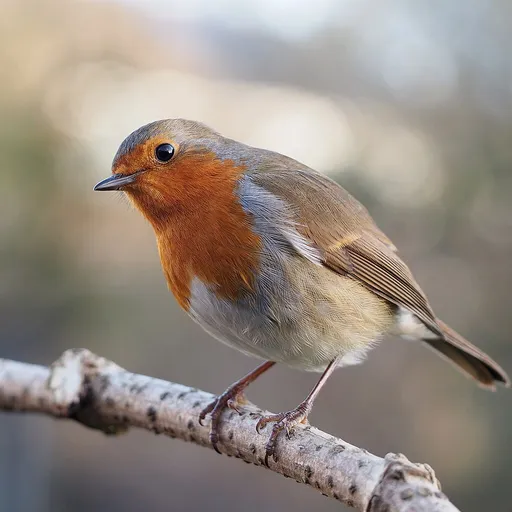
European Robin
Erithacus rubecula
Least Concern
Listen
XC788065 · Carlo Fracasso · San Massimo, Province of Campobasso, Molise, Italy · CC0 1.0
Overview
The European robin (Erithacus rubecula), known as the robin redbreast in the British Isles, is a small insectivorous passerine bird belonging to the Old World flycatcher family. It is found across Europe, Western Siberia, and North Africa, and is classified as Least Concern on the IUCN Red List.
Identification
- Adult males and females are 12.5–14.0 cm long with an orange-toned red breast and face lined with bluish grey, brown upperparts, and a whitish belly.
- Juveniles are spotted brown and white, lacking the red breast until orange feathers gradually appear under the chin and extend to the breast.
- Legs and feet are brown, while the bill and eyes are black.
- First-winter immatures resemble adults but have more obvious yellow-brown tips to the wing covert feathers.
Habitat
The species ranges across Eurasia from Western Siberia in the east to Algeria in the south, and on Atlantic islands as far west as the Azores and Madeira. It is sedentary in the west and south of its range, while northern and eastern populations migrate during harsher winters. Continental European migrants prefer spruce woods, whereas British and Irish robins favour parks and gardens.
Diet
Robins are diurnal foragers that feed on terrestrial invertebrates such as spiders, worms, and insects, supplementing this with berries, fruit, and seeds in autumn and winter. They are relatively unafraid of people and are drawn to digging activities like gardening to find earthworms, and may also consume small vertebrates such as fish and lizards.
Did you know?
Male robins are highly territorial and have been recorded attacking their own reflections, with territorial disputes sometimes resulting in fatalities that account for up to 10% of adult deaths in certain areas. Additionally, some urban robins sing at night to avoid daytime anthropogenic noise, a behaviour linked to vision-based magnetoreception involving quantum entanglement in the eyes.
Sources
- Wikipedia · CC BY-SA 4.0
- Wikidata · CC0 1.0