
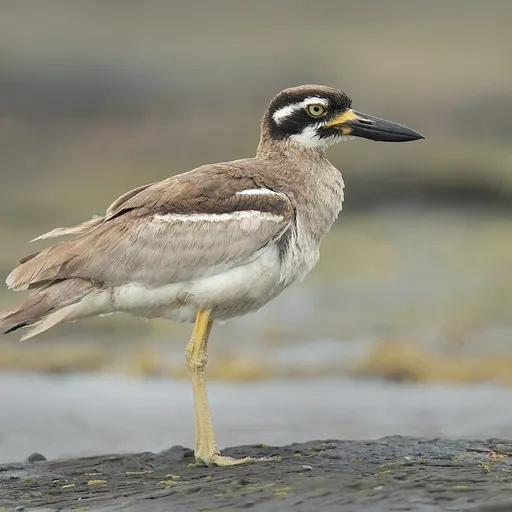
Beach Stone-curlew
Esacus magnirostris
Near Threatened
Overview
The beach stone-curlew (Esacus magnirostris), also known as the beach thick-knee, is a large, ground-dwelling bird found in Australasia and the islands of South-east Asia. At approximately 55 cm in length and 1 kg in weight, it is one of the world's largest shorebirds and the heaviest living member of the Charadriiformes outside of the gull and skua families.
Identification
- Grey-brown upper body with distinctive black and white face patterning and yellow eyes.
- Large size, measuring 54-56 cm (21-22 in) in length.
- Moves slowly and deliberately when foraging, employing slow, rather stiff wingbeats when flying off into the distance.
- Emits a 'chwip-chwip' call as an alarm to ward off intruders from its territory.
Habitat
This species inhabits undisturbed open beaches, exposed reefs, mangroves, and tidal sand or mudflats. Its range extends across coastal eastern Australia from New South Wales as far south as far eastern Victoria, the northern Australian coast and nearby islands, New Guinea, New Caledonia, Indonesia, Malaysia, and the Philippines. It is uncommon over most of its range and rare south of Cairns.
Diet
Beach stone-curlews forage on low tide muddy sand, primarily consuming invertebrates, with a preference for crabs.
Did you know?
Despite being a large bird, the beach stone-curlew lays only one egg per season in a simple nest in the sand just above the high tide line, making the young vulnerable to predation and human disturbance until they reach an impressive 7-12 months of age.
Sources
- Wikipedia · CC BY-SA 4.0
- Wikidata · CC0 1.0