
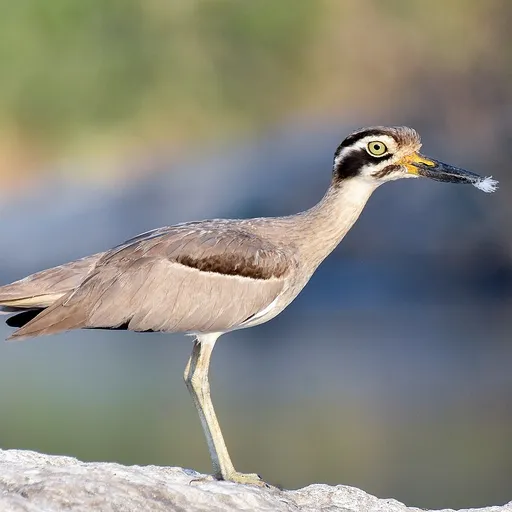
Great Stone-curlew
Esacus recurvirostris
Near Threatened
Overview
The great stone-curlew, also known as the great thick-knee, is a large wader that resides in tropical southern and South-east Asia. It is currently listed as Near Threatened on the IUCN Red List.
Identification
- A large bird standing 49–55 cm tall with a massive 7 cm bill that has an upturned appearance due to a sharp angle in the lower mandible.
- Unstreaked grey-brown upperparts and breast, with whitish lowerparts.
- A striking black and white facial pattern, bright yellow eyes, and duller greenish-yellow legs.
- In flight, displays black and white flight feathers on the upperwing against a mainly white underwing.
Habitat
This species prefers gravel banks along rivers or large lakes, as well as beaches. It is a resident breeder ranging from India, Pakistan, Sri Lanka, and Bangladesh into South-east Asia.
Diet
The great stone-curlew feeds on crabs, large insects, and other animal prey. It forages by moving slowly and deliberately, often with occasional short runs, primarily during the night or at dusk and dawn though it can be seen during the day.
Did you know?
The specific epithet recurvirostris is derived from Latin words meaning 'bent backwards' and '-billed', referencing the distinctive shape of its beak.
Sources
- Wikipedia · CC BY-SA 4.0
- Wikidata · CC0 1.0