
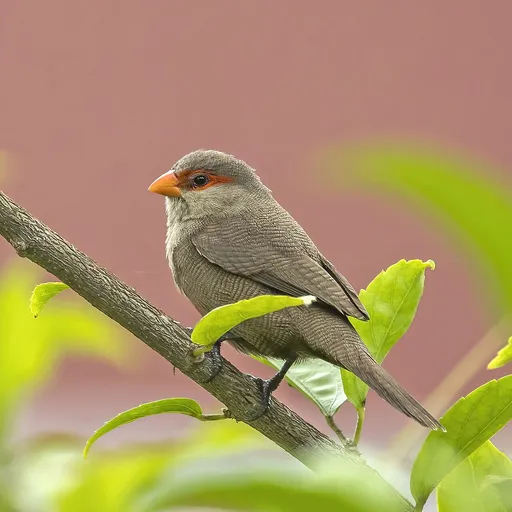
Common Waxbill
Estrilda astrild
Least Concern
Listen
XC431984 · Joost van Bruggen · Aljarafe (near Aznalcázar), Sevilla, Andalucía, Spain · CC BY-SA 4.0
Overview
The common waxbill (Estrilda astrild), also known as the St Helena waxbill, is a small passerine bird belonging to the estrildid finch family. Native to sub-Saharan Africa, it has been introduced to many other regions of the world and maintains a global extent of occurrence estimated at 10,000,000 km².
Identification
- Small bird measuring 9.5–13 cm in length, with a slender body, short rounded wings, and a long graduated tail.
- Plumage is mostly grey-brown, finely barred with dark brown, featuring whitish cheeks and throat and often a pinkish flush to the underparts.
- The adult possesses a bright red bill, resembling the colour of sealing wax, while juveniles have a black bill.
- A distinctive high-pitched flight-call accompanies a variety of twittering and buzzing calls; the simple song is harsh, nasal, and descends on the last note.
Habitat
Native to sub-Saharan Africa, the species is found across much of East, Central, and Southern Africa, excluding desert and dense forest regions. It inhabits open country with long grass and rank vegetation, often near water in marshes and reed beds, and is frequently seen in gardens, parks, and farmland. Introduced populations have established themselves in various warm climates worldwide, including parts of Europe, the Americas, and the Pacific.
Diet
The diet consists mainly of grass and millet seeds, with guinea grasses being a particularly important component due to their year-round availability. Insects are consumed occasionally, especially during the breeding season to provide necessary protein. Birds typically forage in large flocks of hundreds or thousands, clinging to stems with their long claws to pick from flower heads or searching for fallen seeds on the ground.
Did you know?
The common waxbill builds a large nest composed of criss-crossed grass stems with a long downward-pointing entrance tube, often adding a rudimentary second nest on top where the male sleeps. The species is popular and easy to keep in captivity, capable of raising up to four broods in a year under such conditions.
Sources
- Wikipedia · CC BY-SA 4.0
- Wikidata · CC0 1.0