
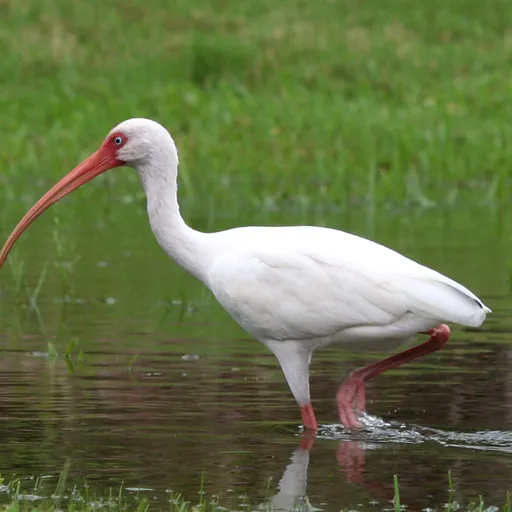
American White Ibis
Eudocimus albus
Least Concern
Overview
The American white ibis (Eudocimus albus) is a medium-sized wading bird found in the southern United States, the Caribbean, and Central and South America. It is a member of the ibis family, Threskiornithidae, and is classified as Least Concern on the IUCN Red List.
Identification
- Overall white plumage with black wing-tips that are usually only visible in flight.
- Long, downward-curving bill and long legs that are bright red-orange in non-breeding condition.
- Main call is a honking sound transcribed as urnk, urnk, or hunk, hunk.
- Males are larger and have longer, stouter bills than females.
Habitat
The species inhabits shallow coastal marshes, wetlands, and mangrove swamps, but is also found in muddy pools, mudflats, and even wet lawns. Its range extends from the southern US East Coast through the Gulf Coast states, the Caribbean, and into Central America and parts of South America. Non-breeding populations range further inland in North America, reaching as far north as Virginia.
Diet
The diet consists primarily of small aquatic prey such as insects, small fishes, and crayfish. The bird forages by probing its beak at the bottom of shallow water to feel for and capture prey, a method that does not rely on sight.
Did you know?
Exposure to methylmercury from untreated waste alters the hormone levels of American white ibises, which affects their mating and nesting behaviour and leads to lower reproduction rates.
Sources
- Wikipedia · CC BY-SA 4.0
- Wikidata · CC0 1.0