
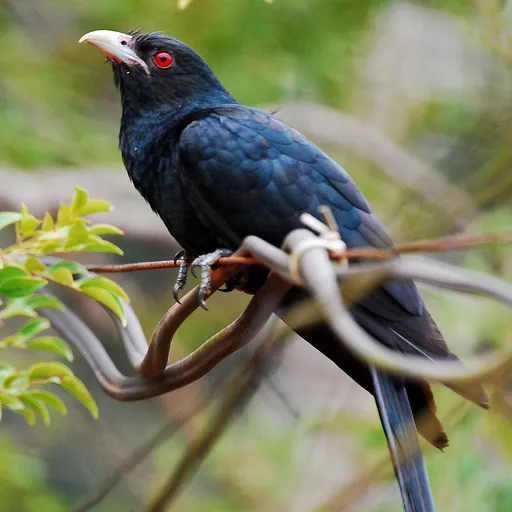
Asian Koel
Eudynamys scolopaceus
Least Concern
Listen
XC923018 · craig wilson · Guindy Race Course (near Chennai), Tamil Nadu, India · CC BY 4.0
Overview
The Asian koel (Eudynamys scolopaceus) is a large, long-tailed cuckoo found in the Indian subcontinent, China, and Southeast Asia. As a brood parasite, it lays its eggs in the nests of crows and other birds, which then raise its young. The species is notable among cuckoos for being largely frugivorous as an adult.
Identification
- Males of the nominate race have glossy bluish-black plumage with a pale greenish-grey bill, crimson irises, and grey legs.
- Females are brownish on the crown with rufous streaks on the head, dark brown backs with white and buff spots, and heavily striped whitish underparts.
- The bird measures 39–46 cm in length and weighs 190–327 g.
- During the breeding season, males produce a familiar repeated 'koo-Ooo' song, while females make a shrill 'kik-kik-kik' call.
Habitat
The Asian koel inhabits light woodland and cultivated areas, acting as a mainly resident breeder across tropical southern Asia. Its range extends from Iran and Pakistan through the Indian subcontinent to southern China and the Greater Sundas. The species demonstrates a strong capacity for colonising new areas, having established populations in Singapore and Krakatau.
Diet
Although omnivorous, adults feed mainly on fruit, capable of swallowing large fruits such as those of palms. They also consume insects, caterpillars, eggs, and small vertebrates. Foragers have been observed defending fruiting trees and chasing away other frugivores.
Did you know?
The word 'koel' is onomatopoeic, derived from the bird's characteristic call. The name is also deeply embedded in culture, with references in the Vedas dating back to approximately 2000 BC, which may represent the earliest written record of brood parasitism.
Sources
- Wikipedia · CC BY-SA 4.0
- Wikidata · CC0 1.0