
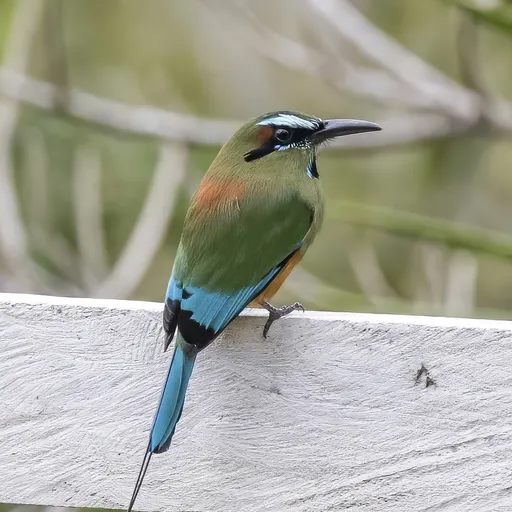
Turquoise-browed Motmot
Eumomota superciliosa
Least Concern
Overview
The turquoise-browed motmot (Eumomota superciliosa) is a colourful, medium-sized bird of the family Momotidae and the sole member of its genus. It is a common resident of Central America, ranging from south-east Mexico to Costa Rica, and is currently classified as Least Concern on the IUCN Red List.
Identification
- A 34 cm long bird with a mostly grey-blue body, contrasting rufous back and belly, and a bright blue strip above the eye.
- Features a blue-bordered black patch on the throat, with blue flight feathers and an upperside of the tail that are also blue.
- Distinctive racket-shaped tail feather tips with bare shafts that are longer than in other motmot species.
- Emits a nasal, croaking call that is described as far-reaching.
Habitat
It inhabits fairly open environments such as forest edges, gallery forests, and scrublands, preferring areas with high tree diversity and dense understory but low open canopy. The species shows a preference for dry forests, a distinction from other regional motmots that favour moist forests, leading to its use as a bioindicator for aridification.
Diet
The bird primarily feeds on insects and small reptiles, employing a sit-and-wait hunting strategy from exposed perches such as overhead utility lines and fence posts. Captured prey is consumed using its flattened, broad, and serrated bill.
Did you know?
In the Mayan dialects of the Yucatán Peninsula, the bird is called 'pájaro reloj' or 'clock bird', a reference to its pendulum-like tail movement. This wagging behaviour, often accompanied by clucking vocalisations, serves as a pursuit-deterrent signal to predators, communicating that the motmot is aware of their presence.
Sources
- Wikipedia · CC BY-SA 4.0
- Wikidata · CC0 1.0