
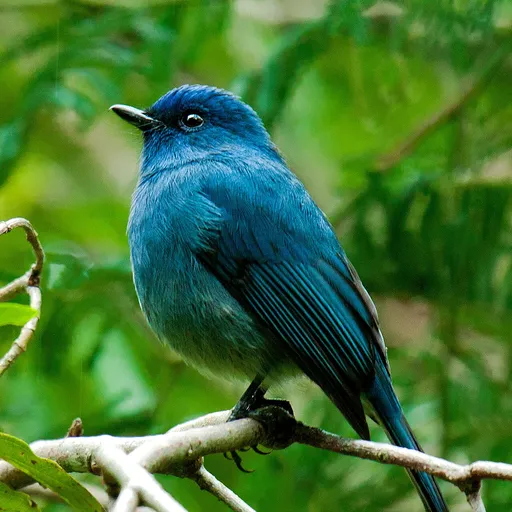
Nilgiri Flycatcher
Eumyias albicaudatus
Least Concern
Overview
The Nilgiri flycatcher (Eumyias albicaudatus) is an Old World flycatcher with a very restricted range in the hills of southern India. It was formerly known as the Nilgiri verditer flycatcher due to its resemblance to the winter migrant verditer flycatcher.
Identification
- Approximately 13 cm in length, this small, long-tailed bird is dark steely indigo blue with some violet-blue on the forehead and darker lores.
- Females are duller, with dark brown upperparts and dark grey underparts; juveniles are dark brown with creamy spots and a scaly appearance on the throat and breast.
- The bill and legs are black, and the iris is dark brown; two small white patches are present at the base of the tail but are not easily visible when the bird is sitting.
- The song consists of rich warbling notes resembling the call of the pied bushchat, while the usual call is a soft nasal chipping 'eep' produced while flicking the tail up and down.
Habitat
Found mainly in the higher altitude shola forests of the Western Ghats and the Nilgiris, this species inhabits the higher hills (mostly above 1200 m) of the Nilgiris, Palni Hills, Anaimalai Hills, the Brahmagiri, Bababudan Hills, and Biligiriranga Hills.
Diet
Like most flycatchers, it makes sallies to capture insects and returns to its perch. It forages mainly in the lower storey but can sometimes be found on top of the canopy.
Did you know?
The nest is built in a cavity in an earth bank or a tree hole, and the species also utilises the eaves of houses and the wood-work of bridges.
Sources
- Wikipedia · CC BY-SA 4.0
- Wikidata · CC0 1.0