
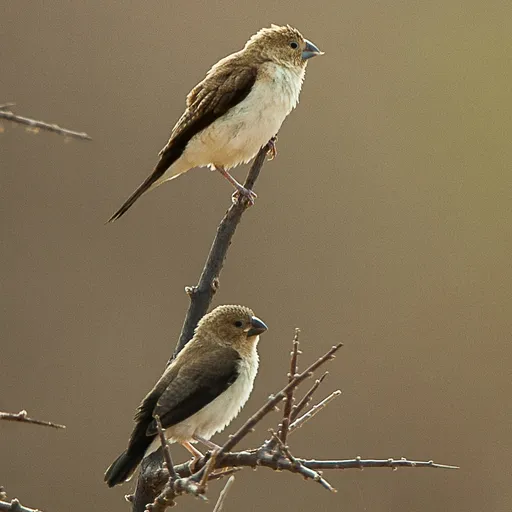
African Silverbill
Euodice cantans
Least Concern
Overview
The African silverbill (Euodice cantans) is a small passerine bird classified as an estrildid finch, formerly considered conspecific with the Indian silverbill. It is a common resident breeding bird found throughout sub-Saharan Africa, with additional populations established in Portugal, Qatar, and the United States.
Identification
- Approximately 10 cm in length with a long black pointed tail.
- Stubby silver-blue bill and finely vermiculated light-brown upperparts.
- Whitish underparts, a black rump, and black wings.
- Distinctive trilling song and a 'tseep' contact call, with the male using a single note and the female a double-noted 'tsiptsip'.
Habitat
This species inhabits dry savanna, arid landscapes with thorn bush, and grasslands featuring acacias or dry grass, extending from lowlands up to 2,000 m altitude. It is also frequently observed in cultivated areas and is primarily a bird of dry country south of the Sahara Desert.
Diet
The African silverbill feeds mainly on grass seeds, foraging by picking them from the ground or clinging to grass stems to extract seeds from inflorescences. While its diet is largely vegetable matter, it has also been recorded taking aphids from water mint.
Did you know?
The male performs an elaborate courtship display where he grasps a stem of grass, sleeks his feathers, and twists his tail towards the female before singing and dancing. Successful mating is typically followed by a bout of bill fencing and mutual preening between the pair.
Sources
- Wikipedia · CC BY-SA 4.0
- Wikidata · CC0 1.0