
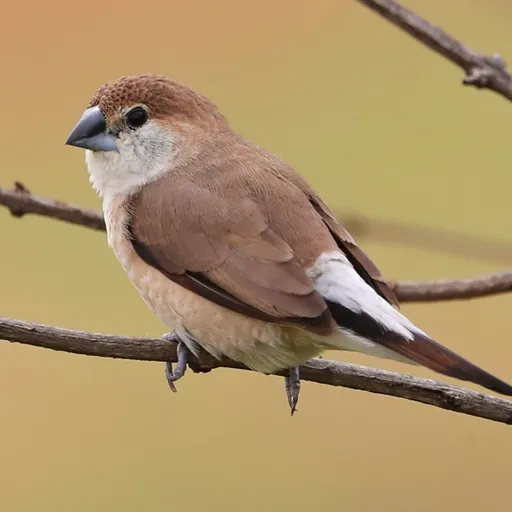
Indian Silverbill
Euodice malabarica
Least Concern
Overview
The Indian silverbill, also known as the white-throated munia (Euodice malabarica), is a small passerine bird found in the Indian subcontinent and adjoining regions. It is a common resident breeding bird in the drier regions of the Middle East and the Indian subcontinent, and has been introduced to many other parts of the world.
Identification
- 11–11.5 cm long with a conical silver-grey bill.
- Buff-brown upperparts, white underparts, and buffy flanks.
- Dark wings contrasting with a white rump and a black tail.
- Males and females are similar, but immatures have buff underparts and a shorter tail.
Habitat
The Indian silverbill frequents dry open scrub, fallow land, and cultivation, sometimes near water. Although mainly found on the plains, they can be found up to about 1200 m in some sub-Himalayan regions. Its native range includes Pakistan, Nepal, Bangladesh, India, Sri Lanka, Iran, and Israel, with established populations in various other global locations.
Diet
It feeds mainly on a wide range of grass seeds and crop species, but also takes insects and visits nectar-bearing flowers such as those of Erythrina trees. They forage on the ground or on low shrubs and grass stalks in small flocks.
Did you know?
The species has been accidentally introduced to many parts of the world, establishing itself in locations such as Puerto Rico, Nice in southern France, and Egypt since 2019. Some females are known to lay their eggs in the nests of other pairs, and old nests are used as dormitories for roosting throughout the year.
Sources
- Wikipedia · CC BY-SA 4.0
- Wikidata · CC0 1.0