
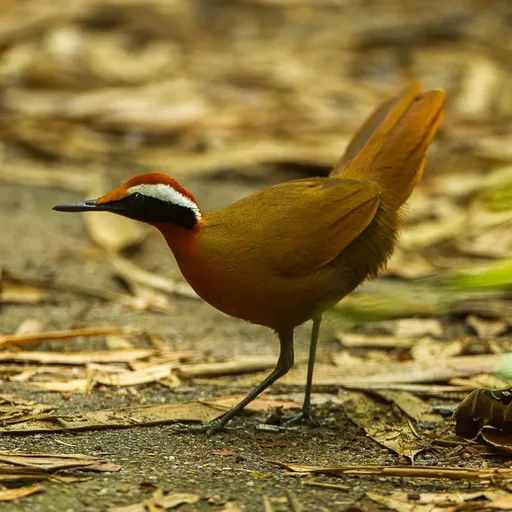
Rail-babbler
Eupetes macrocerus
Near Threatened
Overview
The rail-babbler (Eupetes macrocerus) is a medium-sized, ground-living songbird and the sole member of the family Eupetidae. It is classified as Near Threatened due to significant population declines caused by the loss and degradation of lowland primary forests.
Identification
- Medium-sized and slender, measuring 28 to 30 cm in length with a long thin neck, long black bill, long legs, and a long tail.
- Plumage is mainly brown with a reddish forehead and crown, and a rich chestnut foreneck, chin, and throat.
- Features a long black eyestripe extending to the side of the neck and a broad white supercilium above it, alongside a patch of bare blue skin on the side of the neck that becomes visible during displays.
- Produces a long, monotonous whistling call, switching to a series of frog-like notes when agitated.
Habitat
This species inhabits the floor of primary tall lowland forests, as well as swamps and heath forest, and occasionally lower montane forests up to about 1,060 m in Peninsular Malaysia and 900 m in Sumatra and Borneo. Its range includes the Malay Peninsula (southern Thailand and Peninsular Malaysia), Sumatra, Borneo, and the Natuna Islands.
Diet
The rail-babbler feeds mainly on insects such as cicadas and beetles, along with spiders and worms. It forages on the forest floor by dashing after prey items.
Did you know?
Despite its name, it is more closely related to the rockjumpers of New Guinea than to true rail-babblers, a relationship initially overlooked because of its superficial similarities to African rockfowl. Its shy and secretive nature means it is rarely seen, often preferring to run like a chicken when disturbed rather than fly.
Sources
- Wikipedia · CC BY-SA 4.0
- Wikidata · CC0 1.0