
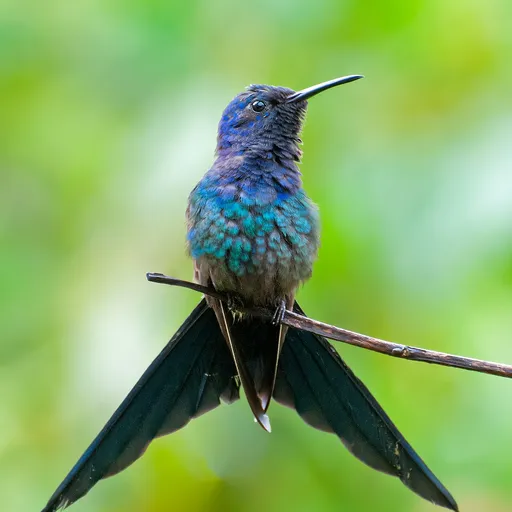
Swallow-tailed Hummingbird
Eupetomena macroura
Least Concern
Overview
The swallow-tailed hummingbird (Eupetomena macroura) is a species in the hummingbird family found mainly in east-central South America. As its name suggests, it is recognised for its long, deeply forked tail that resembles that of a swallow. In much of its range, it is the largest species of typical hummingbird.
Identification
- Total length of 15–17 cm, with nearly half composed of the tail; weighs up to 9 g.
- Brilliant iridescent green plumage with blue head, upper chest, tail, and vent; subspecies vary from green-tinged blue to deep royal blue and golden bronzy-green to blue-tinged green.
- Slightly decurved, medium-long black bill of mediocre length relative to body size.
- Voice includes relatively loud psek notes, weaker twitters, and a tik call when excited or alarmed.
Habitat
Primarily found in the Caatinga and Cerrado of Brazil, adjacent parts of northern and eastern Bolivia, and far northern Paraguay. It generally avoids humid rainforest interiors but occupies semi-open habitats such as savannas, woodland edges, and even urban gardens and parks in major cities like Rio de Janeiro and São Paulo. Though generally a lowland species, it occurs locally up to 1,500 m.
Diet
Chiefly feeds on flower nectar from families such as Fabaceae, Gesneriaceae, and Bromeliaceae, but is not a specialised feeder and will also take insects by hawking. In urban areas, it is commonly attracted to artificial hummingbird feeders. Foraging occurs at mid-levels, though good food sources are exploited from near ground level to the tree tops.
Did you know?
Despite its small size, the swallow-tailed hummingbird is aggressively dominant, diving at birds twice its length or more, such as Campo flickers and smooth-billed anis. A female has even been observed attacking a Swainson's hawk, which weighs more than a hundred times as much as the hummingbird, in mid-air.
Sources
- Wikipedia · CC BY-SA 4.0
- Wikidata · CC0 1.0