
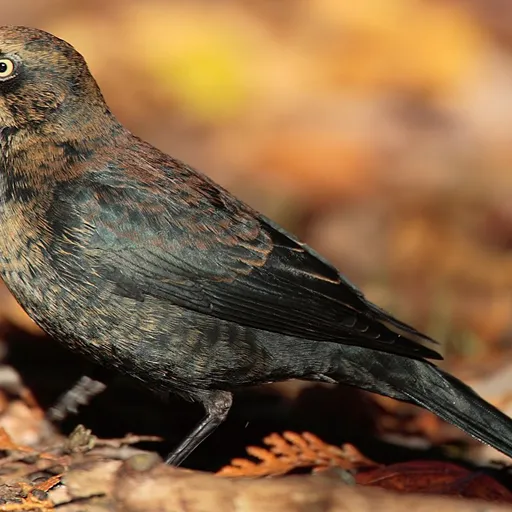
Rusty Blackbird
Euphagus carolinus
Vulnerable
Overview
The rusty blackbird (Euphagus carolinus) is a medium-sized New World blackbird that prefers wet forested areas. It breeds in boreal forests across northern Canada and migrates southeast to the United States for winter. Classified as Vulnerable on the IUCN Red List, the species has experienced a dramatic population decline in recent decades.
Identification
- Adults possess a pointed bill and pale yellow eyes, with black plumage that displays a faint green and purple gloss.
- The name 'rusty' derives from the brownish plumage visible in winter, distinguishing it from its glossy breeding appearance.
- Females appear greyer than males, and the bird is distinguished from the similar Brewer's blackbird by its shorter bill and lack of iridescent green on the head.
- The song comprises gurgling sounds mixed with high-pitched squeaks.
Habitat
Breeding occurs in wet temperate coniferous forests and muskeg across Canada, New England, the Upper Peninsula of Michigan, the Adirondack Mountains, and Alaska. These birds migrate to the eastern and southeastern United States, including parts of the Grain Belt, with vagrants occasionally reported in Mexico, Greenland, and Russian Siberia. The largest wintering concentrations are located in the lower Mississippi Valley, with smaller groups found on the Piedmont and South Atlantic coastal plain.
Diet
During the breeding season, they forage on wet ground or in shallow water for insects, crustaceans, and small fish, with emerging dragonflies and their larvae being particularly important. In winter, their diet becomes more flexible, incorporating grains such as corn and rice, seeds from mast-producing trees like pecans and oaks, and occasionally small passerine birds during extreme food shortages.
Did you know?
The species has undergone one of the most rapid declines of any abundant bird species in North America, dropping by 85% to 98% in the past 40 years, yet the primary reasons for this collapse remain poorly understood. A particularly grim factor is that they may be killed when deltamethrin poison is applied to control brown-headed cowbirds and other species in mixed flocks.
Sources
- Wikipedia · CC BY-SA 4.0
- Wikidata · CC0 1.0