
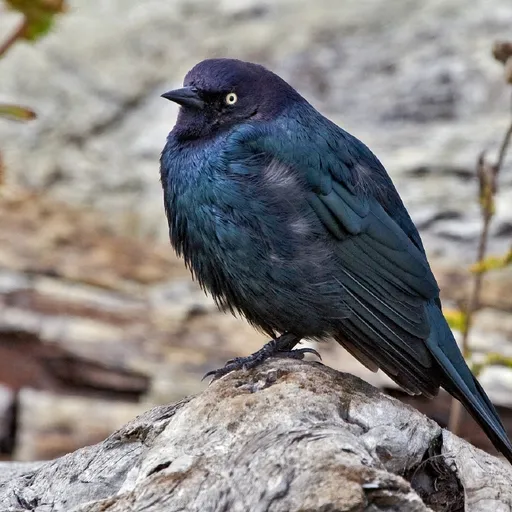
Brewer's Blackbird
Euphagus cyanocephalus
Near Threatened
Overview
Brewer's blackbird (Euphagus cyanocephalus) is a medium-sized New World blackbird named after the ornithologist Thomas Mayo Brewer. Listed as Near Threatened on the IUCN Red List, the species has experienced a significant 57% decline in numbers between 1966 and 2019, with an estimated 23 million remaining in the wild.
Identification
- Adult males feature black plumage with an iridescent purple head and neck, complemented by glossy bluish-green highlights on the rest of the body.
- Males possess bright yellow eyes and black legs, while females are brownish-grey with dark brown eyes and faint hints of iridescence.
- Distinguished from the common grackle by a shorter tail and from the rusty blackbird by a shorter bill and specific head iridescence.
- Emits a sharp check call that serves as a key auditory identifier in the field.
Habitat
Breeding habitat comprises open and semi-open areas, frequently situated near water across central and western North America, with a range that is currently expanding eastward into the Great Lakes region. These adaptable birds thrive in diverse environments such as marshlands, forests, and low-elevation zones as low as sea level in Southern California, while also tolerating elevations up to 8,000 feet. They are often permanent residents in the west, though others migrate to the Southeastern United States and Mexico in spring.
Diet
Primarily consuming seeds, insects, and some berries, Brewer's blackbirds forage in shallow water or fields and occasionally catch insects in flight. In marshy areas, they stand on aquatic plants and wade in shallow water to capture insects, while in colder months they form flocks to forage collectively. Demonstrating opportunistic behaviour, they have been observed following vehicles that plow fields to eat churned-up insects, and occasionally feed on smaller mammals, amphibians, and the nestlings of other birds.
Did you know?
When faced with threats such as hawks or humans, Brewer's blackbirds do not merely flee but actively dive towards the intruders while emitting alarm calls, and may even resort to physical force if particularly threatened.
Sources
- Wikipedia · CC BY-SA 4.0
- Wikidata · CC0 1.0