
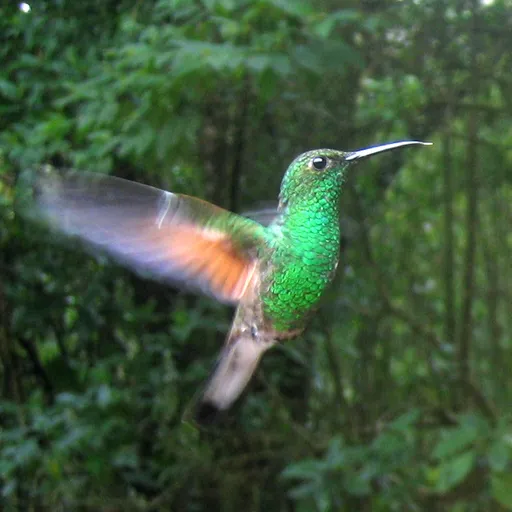
Stripe-tailed Hummingbird
Eupherusa eximia
Least Concern
Overview
The stripe-tailed hummingbird (Eupherusa eximia) is a small species of hummingbird in the Trochilidae family, found from southeastern Mexico to Panama. It is currently classified as Least Concern by the IUCN, though its population size and trend remain unknown.
Identification
- Measures 9 to 10.5 cm in length and weighs 4–4.5 g, featuring a straight black bill.
- Males display bright metallic grass-green upperparts and underparts, with cinnamon-rufous secondaries visible as a patch on the folded wing.
- Females have brownish-gray underparts with metallic green spots on the sides and similar tail markings to males but with added dusky to black tips on inner feathers.
- The tail has dark bronze-green inner feathers and outer pairs with black outer webs and white inner webs with black tips, which gives the species its common name.
Habitat
Inhabits the edges and interior of humid montane, semi-deciduous, and pine-oak forests, as well as plantations. Its range spans from the Caribbean slope of the highlands in Mexico and Central America to both slopes in Costa Rica and western Panama, at elevations from near sea level up to 2,450 m. It makes seasonal elevational movements, breeding at higher altitudes and descending after the breeding season.
Diet
Forages for nectar at all forest levels but most often in the canopy, while females regularly forage in the understory. Males aggressively defend patches of flowers, favouring plants such as Inga trees, Acanthaceae and Rubiaceae shrubs, epiphytes, and the flowers of Clusia, Besleria, and Salvia.
Did you know?
Males of the stripe-tailed hummingbird exhibit aggressive territorial behaviour, often defending specific patches of flowers against other individuals.
Sources
- Wikipedia · CC BY-SA 4.0
- Wikidata · CC0 1.0