
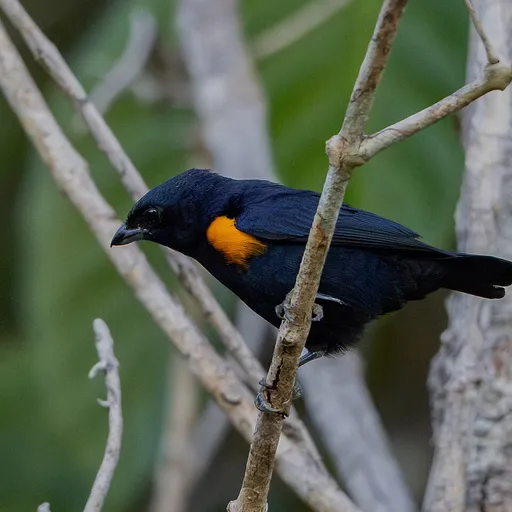
Golden-sided Euphonia
Euphonia cayennensis
Least Concern
Overview
The golden-sided euphonia (Euphonia cayennensis) is a small bird in the family Fringillidae, native to northern South America. It is currently classified as Least Concern by the IUCN, although its population is believed to be decreasing.
Identification
- A smallish euphonia measuring approximately 11 cm in length with a stout bill.
- Males are almost entirely dark glossy steel-blue, featuring a distinctive patch of elongated golden-yellow pectoral feathers that protrude in front of the wing.
- Females have a yellowish forehead and face, an olive crown and upperparts, olive-yellow sides, and gray underparts.
- Both sexes possess dark brown irises, dark gray legs, and a blackish maxilla with a blue-gray base and a blue-gray mandible with a blackish tip.
- Vocalisations include a low, harsh, and gravelly 'j'a'a'a'a' repeated 2–6 times, a buzzy rattle, and a nasal 'ruee-e-et'.
Habitat
Found from northeastern eastern Venezuela across the Guianas to the Atlantic and across northern Brazil from the Negro River east to the Atlantic. It inhabits the canopy and edges of humid evergreen forest, secondary forest, and drier patches of scrub and woodlands in savanna. Elevation reaches up to 1,100 m in Venezuela and 600 m in Brazil.
Diet
The species feeds primarily on small fruits, supplemented by smaller amounts of insects. It forages mainly in the canopy but descends to the shrub layer in clearings and on edges, often singly or in pairs, and occasionally joins mixed-species feeding flocks. It characteristically twitches or wags its tail while foraging.
Did you know?
Despite being described from a specimen in French Guiana as 'Le tangara noir de Cayenne', it was originally placed in the genus Tanagra and later reclassified into Euphonia, which moved from the tanager family to the finch family. Its breeding season includes November in Brazil, and its nest is a moss ball with a side entrance.
Sources
- Wikipedia · CC BY-SA 4.0
- Wikidata · CC0 1.0