
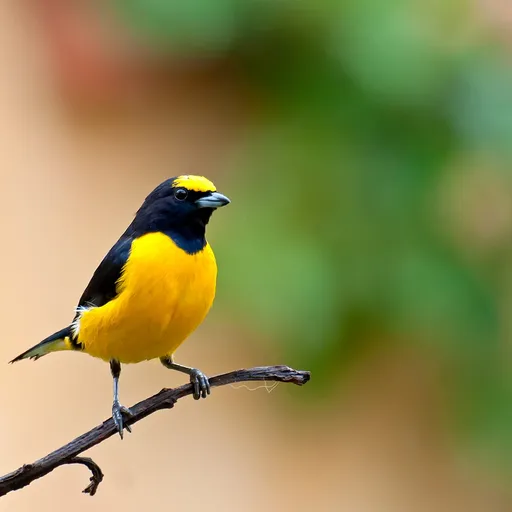
Purple-throated Euphonia
Euphonia chlorotica
Least Concern
Overview
The purple-throated euphonia (Euphonia chlorotica) is a species of bird in the family Fringillidae, native to mainland South America except Chile. It is characterised by a disjunct distribution and is currently assessed as being of Least Concern by the IUCN.
Identification
- Males feature a bright yellow forehead and forecrown, with glossy blue-black upperparts that appear purplish in good light, and bright yellow underparts.
- Females are predominantly olive with a yellowish forehead, dusky lores, and olive-yellow underparts with a whitish central breast.
- Both sexes are small, measuring 9 to 10 cm in length, and possess a blue-gray bill with a blackish tip and dark gray legs.
- The song consists of a jumbled series of squeaks, harsh notes, and whistles, while calls are high, clear, whistled notes such as 'teee, deee'.
Habitat
Inhabiting most of South America, this species is primarily found outside of forest or on its edges, including dry to humid woodlands, gallery forest, mangroves, and savanna borders. It is absent from the interior of the Amazon Basin and the Andes, though it occurs along river systems in Peru and Ecuador. Elevations vary significantly by region, reaching up to 2,000 m in Bolivia and 1,400 m in Peru.
Diet
The bird feeds primarily on the fruits of mistletoe and small fruits such as figs, supplemented by small numbers of insects. It forages mostly in pairs or family groups, occasionally joining mixed-species flocks, and usually feeds high in trees.
Did you know?
Although the breeding season in the wild remains undefined, captive females incubate grayish-white eggs with reddish-brown markings for approximately 15 days, with both parents participating in nestling provision.
Sources
- Wikipedia · CC BY-SA 4.0
- Wikidata · CC0 1.0