
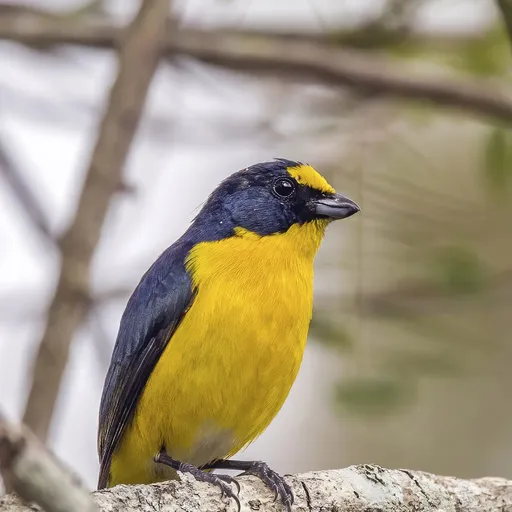
Yellow-throated Euphonia
Euphonia hirundinacea
Least Concern
Overview
The yellow-throated euphonia (Euphonia hirundinacea) is a small, arboreal songbird native to southeastern Mexico and Central America. It is classified as a species of Least Concern due to its stable population and extensive range.
Identification
- Small passerine measuring 10–12 cm in length with pointed wings, a short bill, and a short tail.
- Males feature glossy blue-black upperparts with a distinct yellow forecrown and bright yellow underparts, while females have olive-green upperparts and whitish-grey underparts with yellow flanks.
- Males produce a shrill, choppy song that alternates between high-pitched and moderate notes, often including mimicked calls from other species; females emit thin, high-pitched, trilled calls.
Habitat
Found in dry to humid regions, this species prefers forest edges, open woodlands, shaded plantations, and second-growth areas along river gorges. Its distribution ranges from the lowlands up to 2,100 m in Mexico and typically between 900 m and 1,200 m in western Panama.
Diet
A specialized frugivore, it feeds almost exclusively on fruits, particularly mistletoe berries, figs, and ripe bananas, which it swallows whole after breaking the skin. Although insects contribute less to the adult diet, they are occasionally caught to feed fledglings.
Did you know?
This bird lacks a gizzard, having evolved a simple digestive tract to allow the rapid passage of undigested seeds from its fruit-based diet. It is unusual among Neotropical passerines for feeding its hatchlings regurgitated fruits and seeds rather than insect protein.
Sources
- Wikipedia · CC BY-SA 4.0
- Wikidata · CC0 1.0