
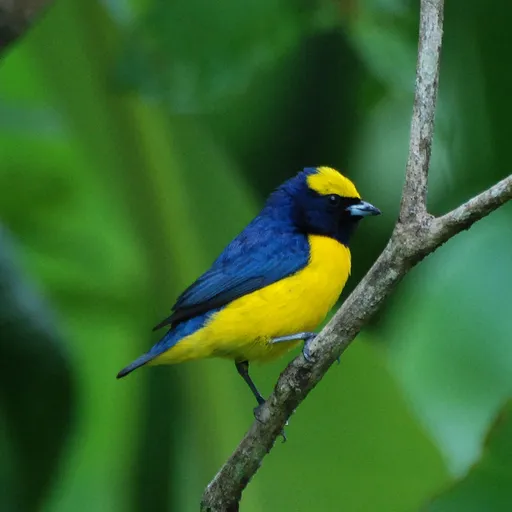
Yellow-crowned Euphonia
Euphonia luteicapilla
Least Concern
Listen
XC958139 · Beth Cottam · Finca Tres Equis - Farm and Forest (near Tres Equis), Turrialba, Cartago Province, Costa Rica · CC0 1.0
Overview
The yellow-crowned euphonia (Euphonia luteicapilla) is a small bird in the family Fringillidae, commonly known as finches and euphonias. It is a resident species found in Costa Rica, Nicaragua, and Panama, and is currently classified as Least Concern on the IUCN Red List with a stable population of at least 500,000 mature individuals.
Identification
- Males: Display a large yellow forecrown and crown that extends past the eye, contrasting with glossy blue-black upperparts, head, nape, and throat, and bright yellow underparts.
- Females: Characterised by an olive head, upperparts, wings, and tail with a yellowish tinge on the forehead, and olive-yellow underparts with a slightly paler center.
- Physical traits: Measures 9 to 10 cm in length and weighs 11.4 to 14.5 g, featuring a short stubby blue-gray bill with a blackish tip, dark brown iris, and dark gray legs.
- Vocalisation: Produces a short, dry sputtering song described as 'pit ditrééa-twiddledee bee bee' or 'chut-tsip ts’tsew tsiuweer', alongside clear high whistled notes like 'ee-bee-bee' and 'tsit' contact calls.
Habitat
This species inhabits tropical and lower subtropical landscapes across eastern Nicaragua, Costa Rica, and northwestern and eastern Panama. It favours semi-open areas such as forest edges, clearings, pastures with trees, and gardens in humid regions, while occupying scrublands and dry forest edges in drier areas. Its elevation range is typically up to 900 m, though it can rarely reach up to 1,900 m in Panama.
Diet
The yellow-crowned euphonia feeds primarily on the fruits of mistletoe and other small fruits, with a probable inclusion of small numbers of insects. It forages mostly in the treetops, either singly, in pairs, or in small groups, wandering widely to locate fruiting trees and often sharing them with other species.
Did you know?
Fledging for this species occurs unusually late, taking 22 to 24 days after hatching, a period notably longer than that of many similar birds. Both parents provision the nestlings by regurgitation, although the female is solely responsible for incubating the two to four eggs for 13 to 14 days.
Sources
- Wikipedia · CC BY-SA 4.0
- Wikidata · CC0 1.0