
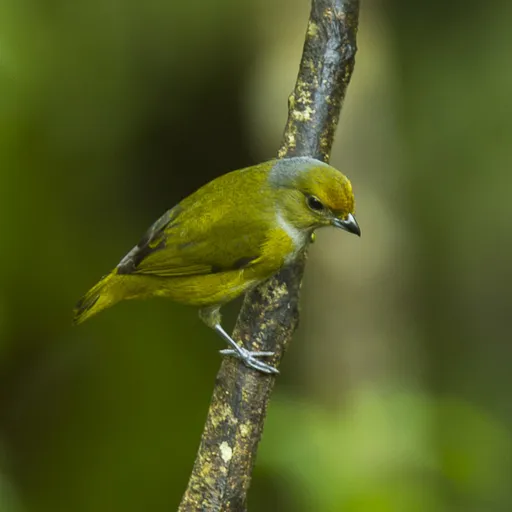
Bronze-green Euphonia
Euphonia mesochrysa
Least Concern
Listen
XC242618 · Niels Krabbe · Morona-Santiago: e-slope Cord. de Cutucú: Uuntsuants, Ecuador · CC BY-SA 4.0
Overview
The bronze-green euphonia (Euphonia mesochrysa) is a small, drab songbird in the finch family Fringillidae. It inhabits the Andean region of South America, found in parts of Colombia, Ecuador, Peru, and Bolivia. The species is currently assessed as Least Concern by the IUCN, although its population is believed to be decreasing.
Identification
- Length of 9 to 10 cm with a weight of 12 to 15 g and a thick, stubby bill.
- Sexually dimorphic; males feature a bright yellow forehead separated by a thin dark olive band from an olive mid-crown, whereas females have an olive forecrown and mid-crown.
- Upperparts are olive with a strong gray-blue gloss; underparts vary from deep ochre-yellow in males to light gray on the belly in females.
- Song described as two clear notes followed by a musical trill, or a whistled note followed by ringing rattles, with a distinctive gravelly call.
Habitat
This species inhabits humid to wet subtropical montane cloudforest, preferring forest on steep hillsides, margins, clearings, landslide scars, and roads. Its elevation range varies by location, generally spanning from 500 to 2,300 m in Colombia and Ecuador, and mostly 1,000 to 2,000 m in Peru. It is a year-round resident in its range, with some suspected elevational movements.
Diet
The bronze-green euphonia feeds primarily on small fruits and berries, likely supplementing this with small amounts of insects. It regularly joins mixed-species feeding flocks and shares fruiting trees with other species, tending to feed mostly in shrubs and small trees.
Did you know?
Nothing is known about the breeding biology of the bronze-green euphonia. Despite occurring across several countries and protected areas, it remains inconspicuous and is not often encountered.
Sources
- Wikipedia · CC BY-SA 4.0
- Wikidata · CC0 1.0