
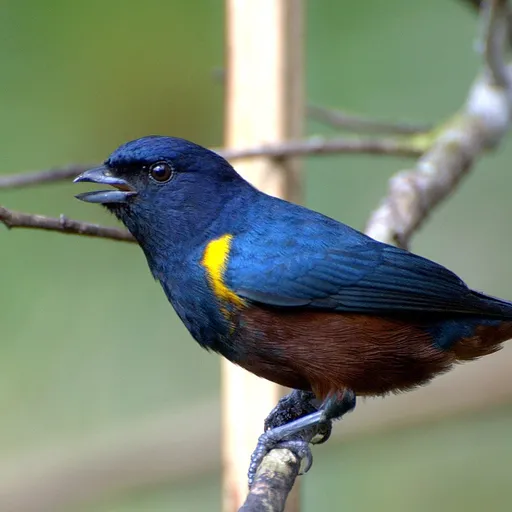
Chestnut-bellied Euphonia
Euphonia pectoralis
Least Concern
Overview
The chestnut-bellied euphonia (Euphonia pectoralis) is a small passerine bird in the family Fringillidae. It is currently assessed as Least Concern by the IUCN, although its population is believed to be decreasing.
Identification
- Size and Build: Approximately 11 cm long and weighing 15–16.5 g, featuring a stout bill.
- Male Plumage: Glossy metallic blue head, breast, and upperparts with dark chestnut underparts below the breast; elongated golden-yellow pectoral feathers protrude in front of the wing.
- Female Plumage: Yellowish forecrown and face, gray crown and nape, olive upperparts, yellow-olive sides, dark rufous vent, and gray underparts.
- Vocalisation: Song consists of a short, harsh series of warbled notes that may imitate other birds; call is a low, rattling, scratchy 'wru-wru-wru-wru-wru'.
Habitat
This species inhabits the canopy, edges, and clearings of humid forests across a range that includes central Brazil, eastern Paraguay, and far northeastern Argentina. A small, isolated population also exists in eastern Brazil's Pernambuco and Alagoas states. Altitudes range from lowlands in Argentina up to 1,300 m in Brazil.
Diet
The chestnut-bellied euphonia feeds primarily on small fruits, supplemented by smaller amounts of arthropods. It forages mostly singly, in pairs, or in small groups, and regularly joins mixed-species feeding flocks, operating from the forest's mid-level to the canopy.
Did you know?
The 'black-throated euphonia' was originally described as a distinct species but is now believed to be a hybrid between the chestnut-bellied and orange-bellied euphonias.
Sources
- Wikipedia · CC BY-SA 4.0
- Wikidata · CC0 1.0