
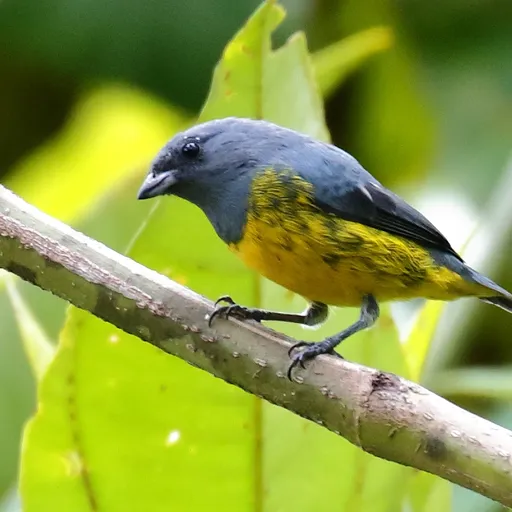
Plumbeous Euphonia
Euphonia plumbea
Least Concern
Overview
The Euphonia plumbea is a small finch and euphonia that was originally described in 1855 and classified in the family Fringillidae. It is a generally resident species found across parts of northern South America.
Identification
- Measures approximately 9 cm in length and weighs about 9 g, with a sexually dimorphic plumage where adult males have a glossy dark gray head and upperparts, while females are duller with a yellowish-gray back.
- Males feature bright yellow underparts from breast to undertail coverts with some gray mottling on the sides, whereas females have olive-yellow breasts and pale olive undertail coverts.
- Both sexes possess a blackish bill with a grayish base, a dark brown iris, and dark gray legs and feet.
- Song is described as a quick, squeaky, jumbled "o'fiddle-de-wEET!" or "WEET sweeta-swee-swee", and the most common call is a high, clear "dee-dee".
Habitat
Found in extreme eastern Colombia, southern Venezuela, Guyana, Suriname, and far northwestern Brazil, with small populations in northern Peru and occasional vagrancy in French Guiana. The species inhabits somewhat open landscapes such as scrubby open woodlands, savannahs, and rock outcrops, typically on nutrient-poor white-sand soil below 1,000 m.
Diet
The plumbeous euphonia feeds primarily on small berries and other small fruits. It typically forages in pairs or family groups, usually in the upper parts of trees.
Did you know?
The species is known for its erratic wandering despite being a general resident, making its occurrence at any given site unpredictable.
Sources
- Wikipedia · CC BY-SA 4.0
- Wikidata · CC0 1.0