
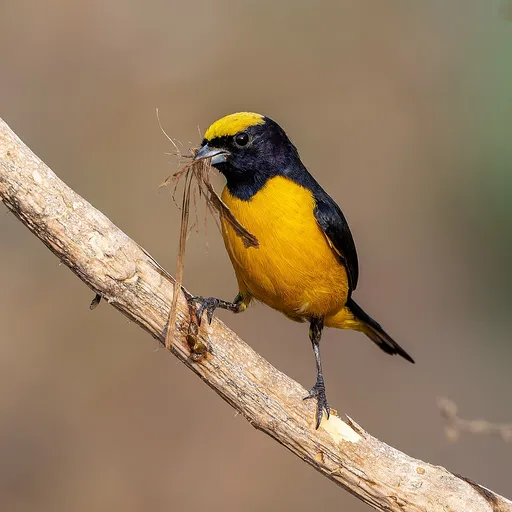
Trinidad Euphonia
Euphonia trinitatis
Least Concern
Overview
The Trinidad euphonia, Euphonia trinitatis, is a small, stocky, and short-tailed passerine belonging to the family Fringillidae. It is primarily found in northern Colombia and Venezuela, where it is common, and on the Caribbean island of Trinidad, where it is uncommon to rare. Classified as a species of Least Concern by the IUCN, it maintains a large range and stable population despite local pressures.
Identification
- Plumage: Males display glossy blue-black heads, backs, and throats with bright yellow foreheads and underparts; females are olive-green above with yellow-olive underparts and a greyish central breast patch.
- Structure: Small and stout, measuring 9.7–11 cm in length, with a black bill featuring a white base to the lower mandible and dark brown irises.
- Flight Markings: Males exhibit white underwing coverts and white bases on the rectrices, appearing as white ovals on the undertail.
- Vocalizations: High-pitched, plaintive whistles including a doubled 'pee' or 'tee' note, a rising 'puwee', and a mournful 'siu'; the song consists of a short, jumbled mix of musical and non-musical notes.
Habitat
The species inhabits dry forest, the edges of moist forest, light woodland, scrub, and cultivated areas, occurring in the tropical zone at elevations up to 1,100 m. It is especially common in arid regions of northern Colombia and Venezuela but is restricted to second growth, hill forest, and mangroves on Trinidad. In moister forests, it is generally replaced by the purple-throated euphonia.
Diet
Primarily a frugivore, it specialises in eating small berries, particularly mistletoes from the genera Loranthus and Phthirusa, along with other fruits, seeds, and invertebrates. It forages noisily and actively from the mid-canopy upwards, collecting insects from spiderwebs and the undersides of small twigs. Notably, it possesses an abnormal stomach lacking a muscular gizzard, an adaptation likely linked to its specialised diet.
Did you know?
The genus name Euphonia is derived from Ancient Greek, meaning 'excellence of tone' or 'euphony'. Additionally, captured birds seldom live long in captivity because owners often lack the specific knowledge required to meet their unique dietary and hygiene needs.
Sources
- Wikipedia · CC BY-SA 4.0
- Wikidata · CC0 1.0