
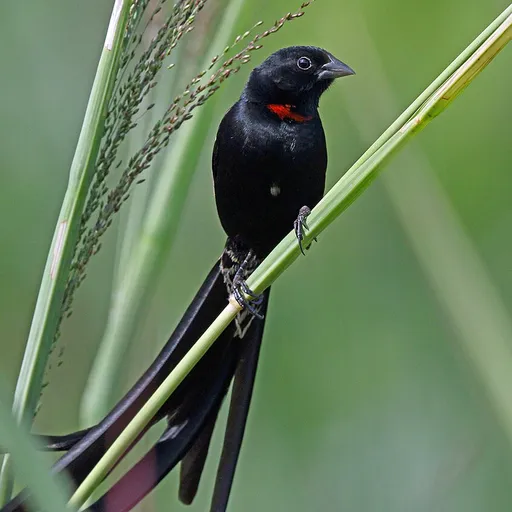
Red-collared Widowbird
Euplectes ardens
Least Concern
Overview
The red-collared widowbird is a species of weaver bird found in western, central, and southern Africa, often associated with other widowbird and bishop species. It is characterised by significant sexual dimorphism and is classified as Least Concern on the IUCN Red List.
Identification
- Males exhibit seasonal plumage changes: brown in non-breeding, and black with a long tail (approx. 22 cm) and crescent-shaped red carotenoid chest patch in breeding season.
- Females and subadults are streaky dull brown with short tails (approx. 4 cm).
- Males are approximately 25 cm in length, whereas females are only about 13 cm.
Habitat
Found throughout Eastern and Southern Africa, this species inhabits open grasslands, agricultural areas, forest clearings, and slopes with limited tree coverage. It is commonly observed in locations such as Kruger National Park in South Africa and parts of Mozambique.
Diet
These birds feed on sorghum and other grass seeds, as well as nectar, small berries, and insects such as ants, caterpillars, and termites. They frequently form large roosts of 50 to 100 individuals to feed together on the ground, often in mixed-species flocks.
Did you know?
The species displays a rare trade-off between sexual ornaments, where the red collar serves as an agonistic signal for male-male competition, while the elongated tail acts as an epigamic signal that directly attracts females. This results in males balancing aggressive dominance signals against female choice criteria, as tail length is negatively correlated with carotenoid signal intensity.
Sources
- Wikipedia · CC BY-SA 4.0
- Wikidata · CC0 1.0