
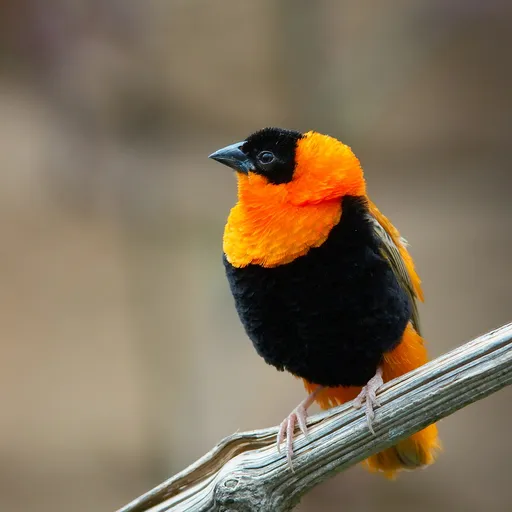
Northern Red Bishop
Euplectes franciscanus
Least Concern
Overview
The northern red bishop, also known as the orange bishop, is a small passerine bird in the family Ploceidae. It is part of the largest genus in this family and is classified as Least Concern on the IUCN Red List.
Identification
- Breeding males display bright reddish orange plumage on the back, chin, throat, and breast, contrasting with a black crown, forehead, flank, and belly.
- Females and non-breeding males have a dilute brown and white feather pattern similar to that of a song sparrow.
- The species is small, measuring about 11 cm in length and weighing 12-22 grams, with a short tail, pale legs, and a black bill.
- Males exhibit a continuous red chin, distinguishing them from the related southern red bishop.
Habitat
Native to northern Africa, the species inhabits tall grasslands or cultivated areas near water and marshes at low elevations up to 1,000 meters. It has also been introduced to parts of the western hemisphere, including Puerto Rico, the West Indies, and the United States.
Diet
The northern red bishop feeds mostly on grass seeds, including millet, and also consumes insects and aquatic vegetation such as Polygonum and Xanthium. They forage on the ground or within grass and weed stems, and may hunt insects in flight.
Did you know?
The male's vibrant red-orange plumage is produced by carotenoid pigments from their diet; captive birds lacking specific carotenoids in their food do not develop the red fraction responsible for this coloration.
Sources
- Wikipedia · CC BY-SA 4.0
- Wikidata · CC0 1.0