
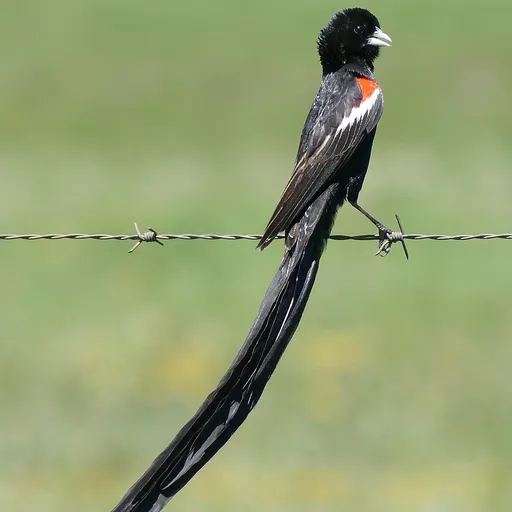
Long-tailed Widowbird
Euplectes progne
Least Concern
Overview
The long-tailed widowbird (Euplectes progne) is a medium-sized bird in the weaver family Ploceidae and one of the most common species in the territories it inhabits. It is found across parts of sub-Saharan Africa and is listed as Least Concern on the IUCN Red List due to its large range and stable population.
Identification
- Adult breeding males: Almost entirely black with orange and white shoulders (epaulets), a bluish-white bill, and extremely long, wide tails that can reach approximately half a metre in length.
- Females: Inconspicuous and streaked tawny and black with pale patches on the chest, breast, and back; they possess narrow tail feathers and horn-coloured bills.
- Flight: Males are readily visible due to their long tails, which they expand vertically into a deep keel while flying with slow wingbeats 0.5 to 2 metres above the ground.
Habitat
Long-tailed widowbirds generally inhabit swampy grasslands, where they live in flocks consisting of one or two males and several females. Their range covers Angola, Botswana, the Democratic Republic of the Congo, Kenya, Lesotho, South Africa, Eswatini, and Zambia, with populations found at elevations up to 2,750 metres in the Drakensberg Mountains.
Diet
The species primarily feeds on seeds, including those of Setaria sphacelata, Paspalum species, and Themeda triandra, supplemented occasionally by arthropods such as beetles, cicadas, aphids, and spiders. They forage mostly in flocks on the ground, though they are occasionally observed hawking insects in the air.
Did you know?
Males' tails are so long that in wet weather the birds become unable to fly due to the weight of the elongated feathers. This trait was central to Malte Andersson's famous experiment, which demonstrated that females prefer supernormal tail lengths, proving female choice as a driver of sexual selection.
Sources
- Wikipedia · CC BY-SA 4.0
- Wikidata · CC0 1.0