
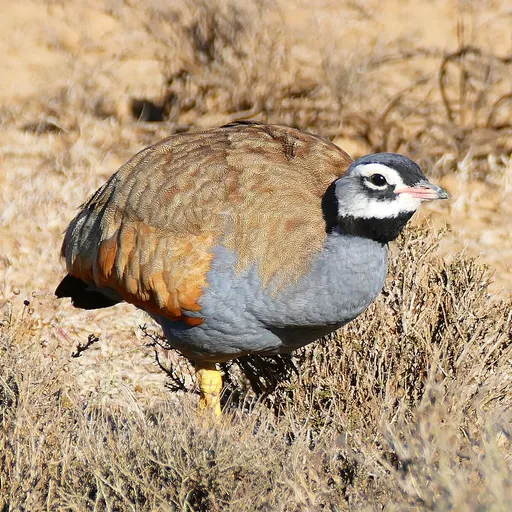
Blue Korhaan
Eupodotis caerulescens
Near Threatened
Overview
The blue korhaan (Eupodotis caerulescens) is a ground-dwelling bird native to South Africa and the western fringes of Lesotho. Classified as Near Threatened by the IUCN, this species inhabits plateau grasslands and arable lands where suitable habitat is gradually being reduced for agricultural use.
Identification
- Large ground-dwelling bird measuring 50 to 58 cm in length, with sturdy bodies, large heads, and long necks.
- Males feature a bluish-grey neck, throat, and underparts, while females have duller grey underparts and buff ear coverts; both sexes have black foreheads and crowns with white head sides.
- Yellow legs and feet with short toes.
- Distinctive throaty 'krok-kau' call, often described as frog-like, usually heard during flight around dawn.
Habitat
Found across an area of approximately 356,000 km² from Pretoria and Mbombela southwards to Bhisho, at altitudes between 1,500 and 3,000 m. The species favours short grass habitats with karoo-type dwarf shrubs and termite mounds, often near water, as well as previously cultivated land, fallows, and winter crops.
Diet
This largely terrestrial bird forages for a varied diet consisting of insects, lizards, scorpions, seeds, flowers, and leaves.
Did you know?
The blue korhaan produces a series of frog-like croaks that are typically uttered in flight. The family group, consisting of the parents and offspring, may stay together for up to two years.
Sources
- Wikipedia · CC BY-SA 4.0
- Wikidata · CC0 1.0