
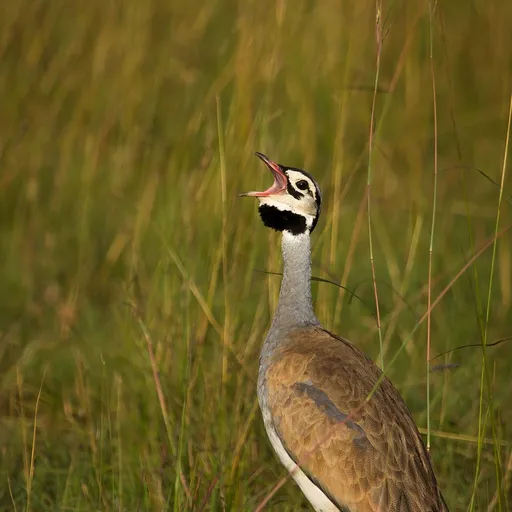
White-bellied Bustard
Eupodotis senegalensis
Least Concern
Listen
XC638474 · paulo kivuyo · Ikoma, Serengeti, Mara Region, Tanzania · CC BY-SA 4.0
Overview
The white-bellied bustard, also known as the white-bellied korhaan, is an African species of bustard. It is widespread in sub-Saharan Africa, inhabiting grasslands and open woodlands. Despite its wide distribution, little is known about its life history and behavior.
Identification
- 48 to 61 cm long, with tawny brown plumage on the back and breast, and a white belly.
- Adults exhibit sexual dimorphism: males have a black crown, black throat patch, and pinkish-red bill, while females have a grey crown and black speckling on the throat.
- Cream-coloured legs and light brown heads in juveniles, transitioning to blue-grey in adults.
- A loud, guttural call often described as "k'whuka WHUKa" or "kuk-kaaah", usually heard at dawn, dusk, or during rainfall.
Habitat
Found exclusively in Africa, this species prefers tall grasslands, savannahs, and open bushland with dwarf trees. Populations in West Africa are better adapted to arid conditions and may venture into deserts during the rainy season, while others favour dense tall grass, river plains, or cultivated areas. Elevations typically range up to 1,500 meters, with some records up to 2,000 meters.
Diet
Omnivorous, the white-bellied bustard feeds on small invertebrates such as beetles, termites, locusts, caterpillars, and spiders, as well as plant matter including seeds, bulbs, berries, and flowers. They forage by moving low to the ground, sometimes entering recently burnt areas to find food.
Did you know?
Young white-bellied bustards stay with their parents much longer than those of other bustard species in the region, often remaining in family groups. Their loud calls can be heard from a distance and frequently trigger responses from other bustard groups far away.
Sources
- Wikipedia · CC BY-SA 4.0
- Wikidata · CC0 1.0