
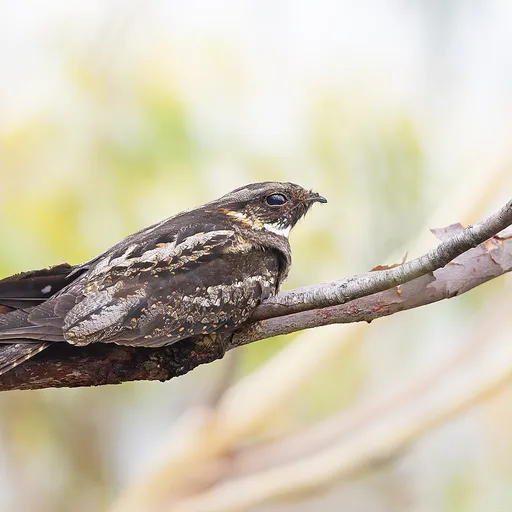
White-throated Nightjar
Eurostopodus mystacalis
Least Concern
Overview
The white-throated nightjar, or white-throated eared nightjar (Eurostopodus mystacalis), is a species of nightjar endemic to eastern Australia. It is classified as Least Concern on the IUCN Red List, although its population trend is currently decreasing.
Identification
- Measures 30–37 cm, making it the largest Australian nightjar, with a dark variegated body and short dark brown legs.
- Upper body is greyish-brown with broad streaks and spots, while the underbody is spotted brown or greyish white with rufous barring.
- Features a large white patch on either side of the throat, resembling a collar, and distinct white spots on the four outermost primaries.
- Song is described as a series of rapidly ascending bubbling notes, often transcribed as wow-wow-wow-wow-ho-ho ho-ho-o-o-O, lasting three to six seconds.
Habitat
This species inhabits a wide variety of environments but is most commonly found in dry low-elevation forests, particularly dry sclerophyll woodlands with sparse understory. It prefers disturbed woodlands, such as those affected by forest fires, and may also be found at the edges of rainforests, mangroves, savannas, and open grasslands. Its range is primarily eastern Australia, with non-breeding winter visits to Papua New Guinea.
Diet
As an aerial hunter, it forages primarily at night by hawking a wide variety of flying insects. Large moths constitute the bulk of its diet, although it also consumes mantises, crickets, grasshoppers, beetles, and winged ants. It may form foraging groups of twenty or more individuals, particularly during migration.
Did you know?
This bird does not construct a nest, instead laying its single egg directly onto leaf litter or bare soil. Both parents take turns incubating, with the female incubating during the day and the male taking over at night to allow the female to hunt.
Sources
- Wikipedia · CC BY-SA 4.0
- Wikidata · CC0 1.0