
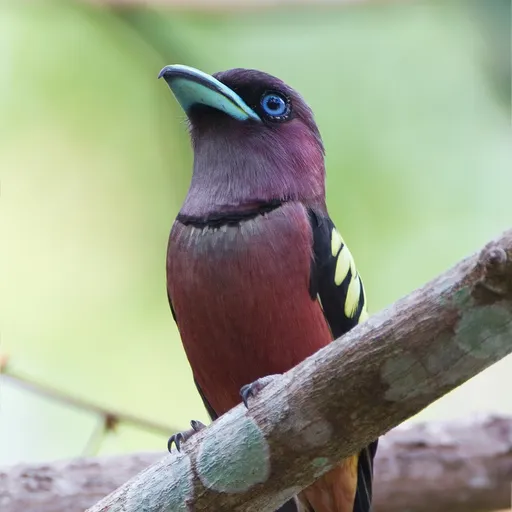
Banded Broadbill
Eurylaimus javanicus
Least Concern
Overview
The banded broadbill, Eurylaimus javanicus, is a species of bird in the typical broadbill family Eurylaimidae found in Mainland Southeast Asia and the Greater Sunda Islands. It is a striking, large-bodied bird that is currently classified as Least Concern on the IUCN Red List.
Identification
- Mostly purplish-red plumage with yellow-streaked black wings, a blackish face, and a greyish chin and upper breast.
- A large bird measuring 21.5–23.0 cm in length with a broad, hooked, bright blue or turquoise beak.
- Females lack the black neckband found on males, though this band can be indistinct in Bornean and Javan males.
- A remarkable, loud song described as a 'wheo' or 'wiuk' followed by a high-speed rattling trill lasting 5–9 seconds.
Habitat
Found across Mainland Southeast Asia and the Greater Sunda Islands, including Vietnam, Thailand, Cambodia, Laos, Myanmar, and the islands of Sumatra, Borneo, Java, and others. It inhabits a variety of forest types, including primary and secondary forests, forest edges, rubber plantations, and Falcataria falcata groves, mainly in lowland areas but occasionally up to 1,500 m on Java.
Diet
The bird mainly eats arthropods such as grasshoppers, katydids, crickets, true bugs, and beetles, but has also been recorded feeding on snails, lizards, frogs, and figs. It forages in a sluggish manner, typically still-hunting from high perches and grabbing prey from nearby branches, occasionally making erratic fluttering flights to glean food.
Did you know?
The species possesses a thick, heart-shaped and wide tongue that allows it to mash and 'chew' its food, facilitating the consumption of relatively large prey.
Sources
- Wikipedia · CC BY-SA 4.0
- Wikidata · CC0 1.0