
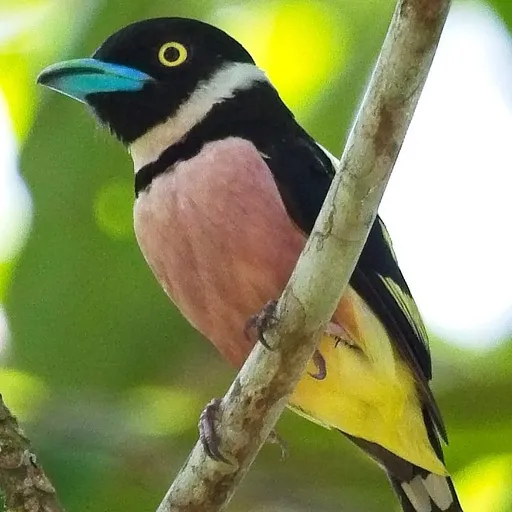
Black-and-yellow Broadbill
Eurylaimus ochromalus
Near Threatened
Overview
The Eurylaimus ochromalus is a small, distinctive bird in the broadbill family Eurylaimidae, native to the tropical forests of Southeast Asia. Listed as Near Threatened by the IUCN, its population is declining due to habitat loss, though it retains some tolerance for secondary forest and plantations.
Identification
- Size: A small bird, 13.5–15 cm long and 31–39 g in weight.
- Plumage: Black head, upperparts, and breastband (the latter incomplete in females) with a white neckband; vinous-pink underparts fading to yellow on the belly; yellow streaking on the back and wings.
- Bill and Legs: Bright blue bill with a green tip to the upper mandible and black edges; reddish legs with long tarsometatarsi.
- Song: A cicada-like bubbling trill that accelerates into a low, quivering note, often performed by calling pairs, alongside shrill mournful peeps.
Habitat
Native to Brunei, Indonesia, Malaysia, Myanmar, Singapore, and Thailand, the species inhabits evergreen, dipterocarp, swamp, and heath forests, as well as forest edges and plantations containing large trees. It is primarily found in lowland areas, reaching elevations of up to 1,220 m in Borneo.
Diet
Mainly insectivorous, feeding on orthopterans, mantises, beetles, and flies, as well as molluscs and incidental fruit. Foraging occurs in the middle and upper forest layers, where birds seize prey from leaf surfaces during short sallies, catch aerial insects in midair, or cling to tree trunks like woodpeckers.
Did you know?
In Borneo, the species occasionally places its large, pear-shaped nests close to beehives, which may provide protection from predators or serve as a food source.
Sources
- Wikipedia · CC BY-SA 4.0
- Wikidata · CC0 1.0