
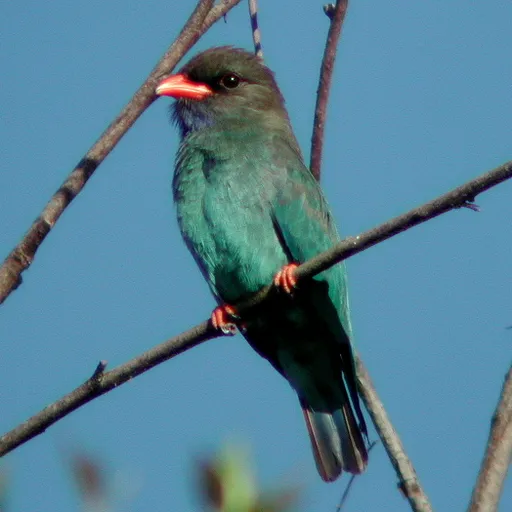
Oriental Dollarbird
Eurystomus orientalis
Least Concern
Overview
The Oriental dollarbird (Eurystomus orientalis) is a bird of the roller family, distinguished by the pale blue or white coin-shaped spots on its wings that give the species its common name. This species is classified as Least Concern on the IUCN Red List.
Identification
- Length of 27–32 cm with a dark brown body heavily washed with a bluish-green sheen on the back and wing coverts.
- Short, wide bill that is orange-red with a black tip in mature birds, appearing dark blackish-grey to brown in immatures.
- Light blue-white patches on the outer wings, highly visible in flight, alongside glossy bright blue throat and undertail coverts.
- Immature birds lack the blue throat colouring and possess duller plumage compared to adults.
Habitat
Found ranging from Australia to Korea, Japan, and India, the species prefers open wooded areas containing hole-bearing trees for nesting. At least two subspecies are migratory, including populations breeding in northeastern Asia and northern Australia.
Diet
The bird hawks for flying insects, typically observed in a distinctive upright silhouette on a bare branch high in a tree. It often returns to the same perch after a few seconds of foraging.
Did you know?
The common name 'dollarbird' is derived from the round bluish-white patch on the wing, which resembles a silver dollar coin and is visible when the bird stretches its wings or in flight.
Sources
- Wikipedia · CC BY-SA 4.0
- Wikidata · CC0 1.0