
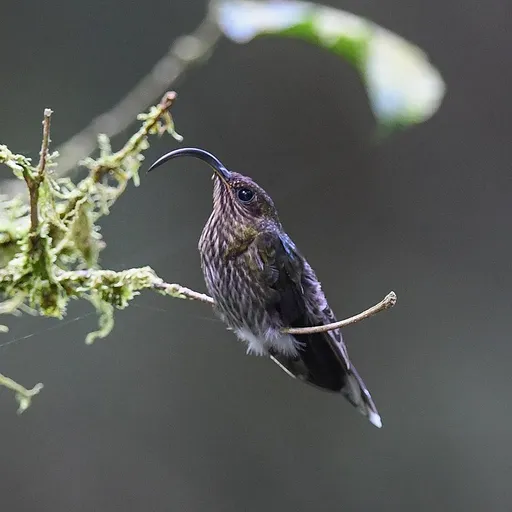
White-tipped Sicklebill
Eutoxeres aquila
Least Concern
Overview
The white-tipped sicklebill is a species of hummingbird found across parts of Central and South America. It belongs to the family Trochilidae and shares its genus with the buff-tailed sicklebill.
Identification
- Upperparts are green with blackish throat and chest, while underparts are striped green and white.
- Length ranges from 11.5 to 13.5 cm with a weight of 8.6 to 14.5 g.
- Features a strongly decurved bill arcing through a quarter circle, with a yellow mandible.
- Song consists of complex thin, whiny squeaks followed by high, tseep notes.
Habitat
The species inhabits the understory of montane evergreen forests in Colombia, Costa Rica, Ecuador, Panama, Peru, and Venezuela. Elevation ranges vary by region, from sea level to 2,000 m, depending on the location within its range.
Diet
Primarily feeds on nectar, often clinging to flowers such as those of Centropogon and Heliconia genera. It also gleans insects from spider webs, trunks, and branches while acting as a trap-line feeder that visits circuits of plants without defending territory.
Did you know?
Females build cup nests that hang from the underside of Heliconia leaves or even human structures like bridges and building ceilings. These nests are woven from a mix of rootlets, hair, fungal rhizomes, and plant fibers bound with spider web.
Sources
- Wikipedia · CC BY-SA 4.0
- Wikidata · CC0 1.0