
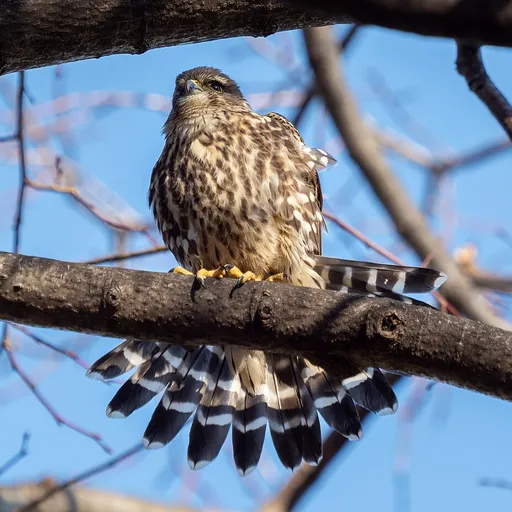
Merlin
Falco columbarius
Least Concern
Overview
The merlin (Falco columbarius) is a small, robust falcon native to the Northern Hemisphere, characterized by its swift flight and skilled hunting abilities. As a bird of prey, it breeds across the northern Holarctic region and is classified as Least Concern on the IUCN Red List.
Identification
- Males exhibit a blue-gray back ranging from silver to black, with buff to orange underparts that are heavily streaked with black or reddish-brown.
- Females and immature birds are brownish-gray to dark brown above and whitish-buff below, spotted with brown.
- The species is compact, measuring 24–33 cm in length, with a yellow cere and yellow feet bearing black claws.
- Tail feathers typically feature three or four wide blackish bands, ending in a black tip with a narrow white band at the very end.
Habitat
Merlins inhabit fairly open country, such as willow or birch scrub, taiga forest, grassland, and moorland, preferring a mix of low and medium-height vegetation while avoiding dense forests. Their range spans North America and Eurasia, with populations migrating to subtropical and northern tropical regions in winter, though some in milder maritime areas become resident.
Diet
These raptors rely on speed and agility to hunt by flying fast and low, often 'tail-chasing' startled birds to capture them in the air. During the breeding season, they predominantly consume small birds weighing 10–40 g, such as larks and finches, but also take larger prey like ptarmigan, insects, small mammals, and reptiles outside of this period.
Did you know?
Merlins are so bold and unafraid that they have been observed attempting to 'catch' moving automobiles and trains, as well as feeding on captive birds snared in mist nets. In the Cayman Islands, the mere presence of a hunting merlin has caused bananaquits to die of apparent heart attacks or strokes from stress without being physically harmed.
Sources
- Wikipedia · CC BY-SA 4.0
- Wikidata · CC0 1.0