
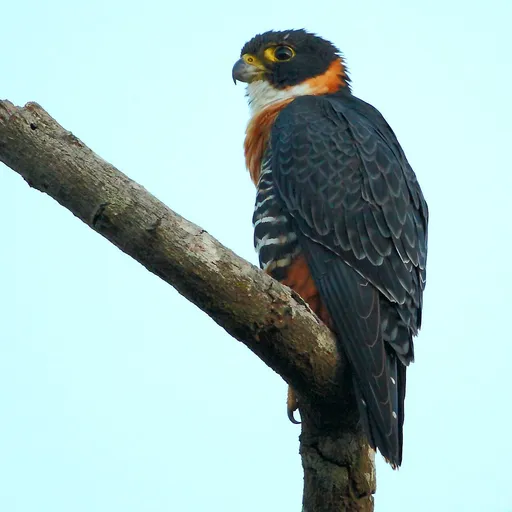
Orange-breasted Falcon
Falco deiroleucus
Near Threatened
Overview
The orange-breasted falcon (Falco deiroleucus) is a bird of prey in the family Falconidae, characterised by its distinct orange breast and large head. Despite its wide nominal range, it is scarce and classified as Near Threatened by the IUCN, with a decreasing population size.
Identification
- Plumage: Adults feature a black head, bluish-black upperparts, and a buffy rufous orange upper breast contrasting with a black lower breast marked by coarse reddish-brown bars.
- Size: The species exhibits the greatest sexual size dimorphism among all falcons, with males measuring 35–36 cm and females 38–40 cm.
- Bill and Legs: The cere, bare eye skin, and legs are typically bright yellow, though they may vary to pale yellow or dull bluish-green; the iris is dark brown.
- Vocalisation: Both sexes are highly vocal during breeding, emitting a rapid-fire 'key-key-key' or 'kyowh-kyowh-kyowh' aggressive defense call.
Habitat
Dependent on tropical rain and semi-deciduous forests, this species requires cliffs for nesting and favours uninterrupted mature forests, though it also occurs in mosaics of forest and open areas. Its range spans southern Mexico, Belize, Guatemala, Panama, and most South American countries, excluding Chile and Uruguay, though it is rare or locally extirpated in much of this area.
Diet
The orange-breasted falcon preys on a wide variety of birds and bats, hunting above the forest canopy by diving from cliffs or dead treetops, or stooping from great heights. It employs a stealth strategy at dusk and dawn, silhouetting migrating songbirds, shorebirds, and bats against the sky to capture them.
Did you know?
A camera trap in Belize recorded a vampire bat feeding on an incubating female orange-breasted falcon, highlighting the diverse predation pressures the species faces. Additionally, some pairs have been documented nesting in non-traditional locations, such as on a temple at Tikal National Park in Guatemala.
Sources
- Wikipedia · CC BY-SA 4.0
- Wikidata · CC0 1.0