
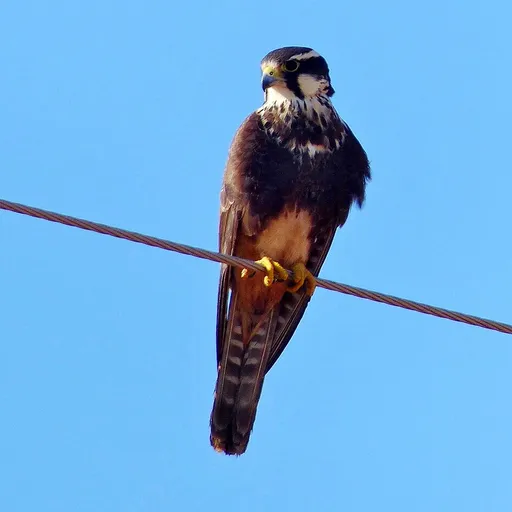
Aplomado Falcon
Falco femoralis
Least Concern
Overview
The aplomado falcon (Falco femoralis) is a medium-sized falcon native to the Americas, characterised by its slender build and long wings. It is classified as a Species of Least Concern by the IUCN, despite being locally extinct in parts of its historical range.
Identification
- Upperparts are dark blue-grey with a white throat and eyestripe, contrasting sharply with black patches on the lower breast and light cinnamon belly.
- Size is similar to a small peregrine falcon, measuring 30–40 cm in length with a wingspan of about 90 cm.
- Tail is black with narrow white or grey bars and a white tip; the cere, eye-ring, and feet are yellow or yellow-orange.
- Juveniles resemble adults but have blackish-brown upperparts, streaked chest, buffy white markings, and paler underparts.
Habitat
The species prefers dry grasslands, savannas, and marshes, ranging from northern Mexico and Trinidad to southern South America. It has become extinct in many parts of its range, including northern and central Mexico, though it is commonly observed in large cities in Brazil, such as São Paulo.
Diet
It feeds primarily on small birds, which make up the overwhelming bulk of its prey, along with large invertebrates and small vertebrates. It often soars at twilight to catch insects on the wing and hunts over burning fields, sometimes cooperating in pairs or following maned wolves to catch flushed birds.
Did you know?
Genetic studies from 2015 revealed that the aplomado falcon is most closely allied to the New Zealand falcon (F. novaeseelandiae), a surprising connection given the vast geographical separation between the species.
Sources
- Wikipedia · CC BY-SA 4.0
- Wikidata · CC0 1.0