
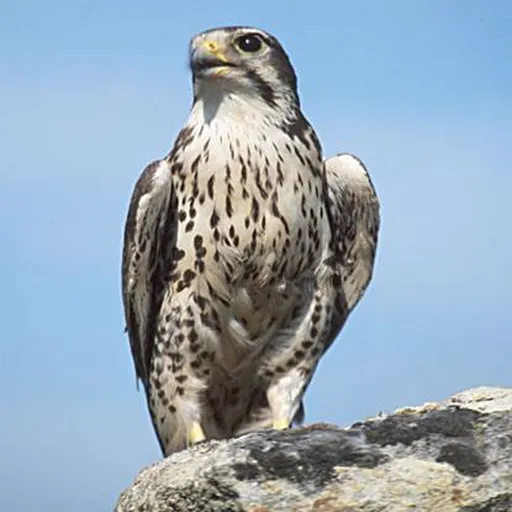
Prairie Falcon
Falco mexicanus
Least Concern
Overview
The prairie falcon (Falco mexicanus) is a medium-sized falcon native to the arid regions of Western North America. Classified as an early divergence from the peregrine falcon lineage, it is the only large falcon species found strictly within North America.
Identification
- Size: Males measure 37–38 cm, while females reach 45 cm, with a wingspan of up to 1.1 m.
- Plumage: Adults feature warm, sandy grey-brown upper parts and pale, mottled underparts, distinguished by black axillars and underwing coverts that create a striped effect.
- Head: Possesses a narrow 'moustache' mark and a white line over the eye, similar to but less prominent than those of the peregrine.
- Flight: Exhibits stiffer, more mechanical wingbeats with a longer tail and more tubular body compared to the peregrine falcon.
Habitat
This species inhabits open country, including shortgrass prairies, high deserts, and alpine tundra. Its breeding range extends from southern Canada through the western United States and into northern Mexico, where it remains largely resident year-round.
Diet
An opportunistic hunter, the prairie falcon primarily consumes small mammals and birds caught in flight, though it occasionally takes larger prey such as geese. Foraging tactics include flying low to surprise prey, stooping from altitude, and using terrain as cover for rapid climbing attacks.
Did you know?
Adapted to desert conditions, the prairie falcon's eggs are less porous and retain water better than those of peregrine falcons, resulting in higher hatching rates in hot, low-humidity environments.
Sources
- Wikipedia · CC BY-SA 4.0
- Wikidata · CC0 1.0